
1. INTRODUCTION
Beetroot (Beta vulgaris L. subsp. vulgaris) is an important root vegetable valued for its nutritional composition, including dietary nitrates, betalain pigments, and antioxidant compounds with potential cardiovascular and anti-inflammatory benefits [1,2]. It is cultivated widely in the subtropical plains of northern India as a key Rabi vegetable. Beetroot requires an adequate and balanced supply of nitrogen (N), phosphorus (P), and potassium (K) for optimum root development and quality. N promotes vegetative growth and chlorophyll synthesis, P supports root proliferation, and K regulates osmotic balance and assimilate partitioning [3].
Despite productivity gains from chemical fertilizers, their excessive use leads to soil structural deterioration, decline in microbial biodiversity, and environmental concerns related to nutrient runoff [4]. Integrated nutrient management, which combines biofertilizers, organic amendments, and reduced inorganic fertilizer levels, has emerged as a viable sustainability strategy [5].
Biofertilizers encompass plant growth-promoting microorganisms that enhance nutrient availability through biological nitrogen fixation, phosphate solubilization, potassium mobilization, and phytohormone synthesis [4]. Azospirillum is an associative nitrogen fixer that promotes root hair proliferation and enhances water and mineral uptake [6]. Azotobacter is a free-living nitrogen fixer that also synthesizes growth-promoting vitamins [7]. Pseudomonas fluorescens solubilizes inorganic phosphates and plays a role in biocontrol of soilborne pathogens [8]. Bacillus subtilis is known for phosphate-solubilizing and plant growth-promoting activities [9]. Frateuria aurantia is a potassium-solubilizing bacterium [10], and arbuscular mycorrhizal fungi (AMF) enhance phosphorus uptake through hyphal networks, improve water absorption, and promote antioxidant accumulation [11].
Organic amendments such as vermicompost can contribute to improved soil fertility by supplying nutrients and enhancing soil physical and biological properties [12]. Their integration with inorganic fertilizers has also been associated with improved growth, yield, and quality of beetroot [13]. Such integrated nutrient-management approaches may therefore help maintain crop productivity while reducing exclusive dependence on mineral fertilizers and supporting more sustainable soil fertility management. [12,13].
Despite increasing evidence supporting biofertilizer effectiveness in vegetable and field crops, including wheat and lettuce [14,15], their combined effects with reduced inorganic fertilizer levels specifically in beetroot (Beta vulgaris L.) under subtropical conditions remain insufficiently explored. Therefore, the present study was undertaken with the following objectives: (1) to evaluate the effect of different biofertilizer combinations on growth, yield, and quality of beetroot; (2) to assess whether biofertilizers can sustain productivity under reduced inorganic fertilizer levels (50% and 75% NPK); and (3) to identify the most effective integrated treatment for sustainable beetroot cultivation under subtropical conditions.
2. MATERIALS AND METHODS
2.1. Experimental Site and Agro-climatic Conditions
The field experiment was conducted during the Rabi season (November 2024–March 2025) at the Research Farm of RSM PG College, Dhampur, Bijnor District, Uttar Pradesh, India (latitude 29.3°N, longitude 78.5°E, altitude 208 m above mean sea level), within the subtropical agro-climatic zone (Zone IV, Indo-Gangetic Plains; mean temperature 10°C–22°C during the crop growth period). The soil was sandy loam in texture with pH 7.2, electrical conductivity 0.38 dS m-1, organic carbon 0.48%, and available N, P, and K of 182, 14.3, and 164 kg ha-1, respectively, determined by standard methods [16–18].
2.2. Experimental Design and Treatments
The experiment was laid out in a randomized block design (RBD) with 18 treatment combinations, each replicated 3 times (54 experimental units; plot size 1.80 m × 3.00 m = 5.40 m²). To maintain comparable soil organic matter across all plots, FYM at 10 t ha-1 was applied uniformly to every plot before sowing [13]. T1, therefore, represents a FYM baseline only (10 t ha-1; no mineral NPK or biofertilizer) treatment with a uniform FYM baseline, and should not be regarded as an absolute control in the strict sense. Treatment details are presented in Table 1.
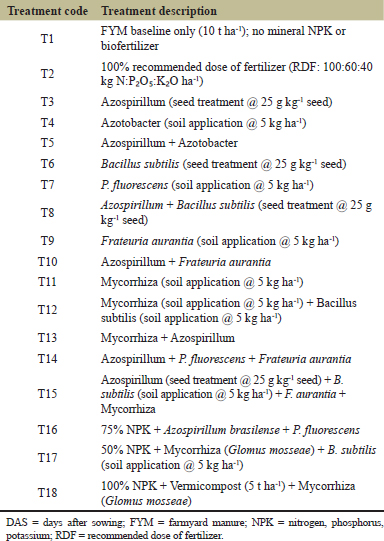 | Table 1. Treatment combinations used in the experiment. [Click here to view] |
2.3. Biofertilizer Preparation and Application
All microbial inoculants were procured from a government-approved biofertilizer production unit and verified for viability (minimum 108 CFU g-1). Seed-treatment organisms—Azospirillum (used throughout, alone or in combination) and Bacillus subtilis when used alone (T6) or combined only with Azospirillum (T8)—were applied at 25 g kg-1 seed using 10% jaggery solution as a sticker, shade-dried for 30 minutes, and sown immediately [5]. Mycorrhiza and soil-applied organisms—Azotobacter, P. fluorescens, F. aurantia, and B. subtilis when combined with Mycorrhiza and/or other soil-applied organisms (T12, T15, T17)— were incorporated into the root zone at 5 kg ha-1 mixed with 50-kg decomposed compost before sowing.
2.4. Fertilizer and Organic Amendment Application
The recommended dose of fertilizers (RDF) was 100:60:40 kg N: P2O5:K2O ha-1 [19], applied as urea (46% N), single superphosphate (16% P2O5), and muriate of potash (60% K2O). Half the N and full P and K were applied basally; the remaining N was top-dressed at 30 DAS. For T16 (75% NPK) and T17 (50% NPK), respective proportions followed the same schedule. Vermicompost (C: N ratio 15:1, @ 5 t ha-1) was incorporated 15 days before sowing in T18 in addition to 100% NPK [13].
2.5. Crop Management
Beetroot cultivar "Detroit Dark Red" was sown at 30 cm × 10 cm spacing (~3.33 lakh plants ha-1; 180 plants per plot). Standard practices–irrigation (6–7 irrigations), weeding (twice at 25 and 50 DAS), and preventive disease management (mancozeb @ 2.5 g L-1 at 45 DAS)–were uniformly followed.
2.6. Observations Recorded
Growth parameters (plant height, number of leaves per plant-1, leaf length, leaf width) were recorded at 60, 75, and 90 DAS on five tagged plants per plot. Leaf area was not measured; leaf dimensions (length and width) were recorded as proxies. Shoot fresh weight and shoot dry weight (oven-dried at 65°C to constant weight) were recorded at 90 DAS. Yield parameters–root diameter, root length, root weight plant-1, root fresh mass, and root dry mass–were recorded at harvest (95 DAS) from five randomly selected plants. Root weight plant-1 denotes the fresh weight of the trimmed, marketable storage root (crown and fine/fibrous rootlets removed) recorded immediately after washing, whereas root fresh mass denotes the fresh weight of the entire, untrimmed root system (storage root together with attached fibrous and lateral roots) from which root dry mass was subsequently obtained after oven-drying; the two parameters are, therefore, not directly comparable. Root yield was calculated on a plot basis and converted to t ha-1. The root-to-shoot dry weight ratio was computed as: root dry mass (g) / shoot dry mass (g). Total soluble solids (TSS) were measured using a hand refractometer (Erma, Japan) and expressed in °Brix [20].
2.7. Statistical Analysis
Data were subjected to ANOVA for RBD following Gomez and Gomez [21]. Treatment means were compared using the critical difference (CD) at 5% level of significance. Statistical analyses were performed using OPSTAT software (CCSNIAU, Hisar, India).
3. RESULTS AND DISCUSSION
3.1. Growth Parameters
Significant variation among treatments was recorded for all growth parameters at 60, 75, and 90 DAS (Table 2; Fig. 1). T16 recorded the highest plant height at 60 DAS (5.50 cm), whereas T18 recorded the highest plant height at 75 and 90 DAS (10.20 and 12.37 cm, respectively), along with the highest leaf length (28.73 cm) at 90 DAS–an improvement of approximately 54.6% in plant height over T1 (8.00 cm at 90 DAS); T17 recorded the numerically highest leaf width (9.33 cm), followed by T18 (9.20 cm), though this difference should be interpreted against CD = 1.38 cm. The greatest number of leaves at 90 DAS was recorded in T16 (9.67 plant-1), followed by T17 (9.20 plant-1) and T18 (8.73 plant-1), indicating that leaf-number response was maximized under partially reduced NPK combined with biofertilizer inoculation, whereas T18 remained the superior treatment for plant height and leaf dimensions. Treatments T16 and T17 performed significantly better than the FYM-baseline treatment (T1) for most vegetative parameters; however, their superiority over sole NPK (T2) was parameter-dependent and must be assessed against respective CD values (e.g., CD = 2.03 cm for plant height at 90 DAS).
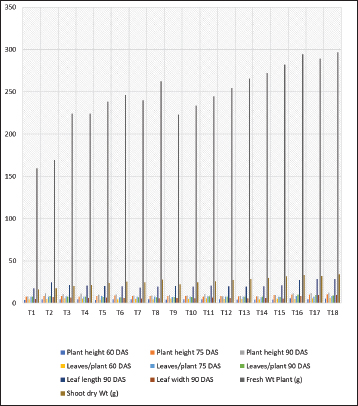 | Figure 1. Effect of different biofertilizers and nutrient management treatments on growth parameters of beetroot (Beta vulgaris L.). [Click here to view] |
| Table 2. Effect of different biofertilizer and nutrient management treatments on growth parameters of beetroot (Beta vulgaris L.). [Click here to view] |
The superior vegetative growth under T18 is attributable to the synergistic interaction among inorganic macronutrients, humic substances from vermicompost, and enhanced phosphorus uptake by mycorrhizal hyphae. Vermicompost and other composted organic amendments improve soil aggregation, water-holding capacity, and microbial activity [12,13,22], while AMF extend functional root surface area through extraradical hyphae, improving uptake of phosphorus and secondary nutrients [11]. These findings are consistent with Maloisane and Kayombo [23], reported improved beetroot growth and yield under vermicompost treatments compared with mineral fertilizer and untreated soil, and Youssef et al. [24], who observed markedly improved plant height under combined AMF and mineral fertilizer in root vegetables.
3.2. Yield and Yield Attributes
Yield parameters differed significantly among treatments (Table 3; Fig. 2). The highest root yield in this experiment (24.95 t ha-1) was recorded in T16 (75% NPK + Azospirillum + P. fluorescens), followed by T18 (24.92 t ha-1) and T17 (24.66 t ha-1); these three treatments were statistically equivalent in root yield (CD = 0.29 t ha-1). This conclusion was verified using unrounded replicate means and the unrounded CD/error term from the ANOVA output, confirming that the equivalence is not an artifact of rounding to two decimal places. Root yield under T16 was 23.8% higher than T1 (20.15 t ha-1) and 21.0% higher than T2 (20.62 t ha-1).
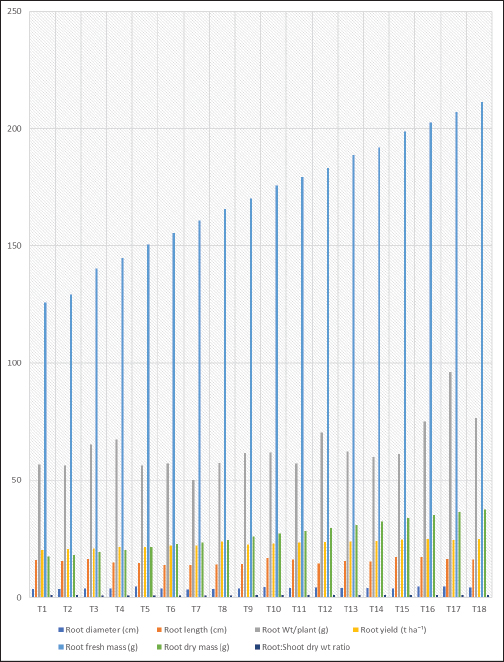 | Figure 2. Effect of biofertilizers and nutrient management treatments on yield attributes of beetroot (Beta vulgaris L.). [Click here to view] |
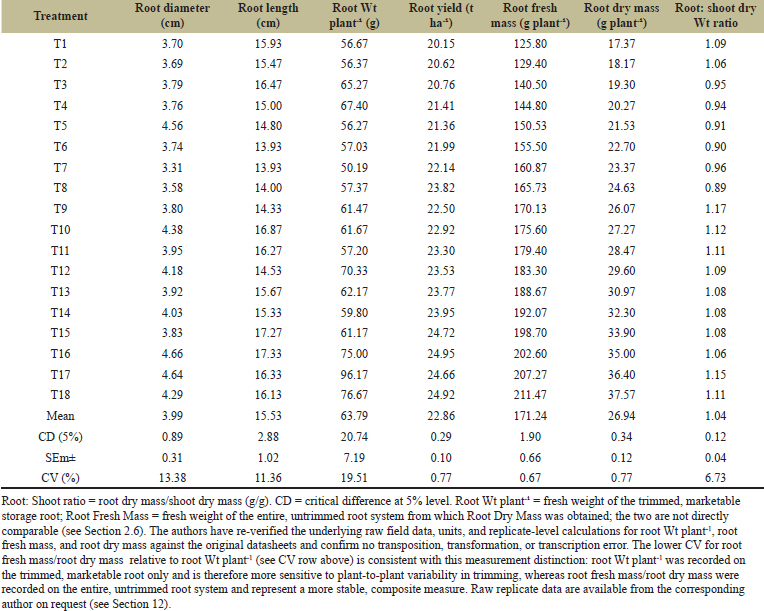 | Table 3. Effect of biofertilizer and nutrient management treatments on yield attributes of beetroot (Beta vulgaris L.). [Click here to view] |
Regarding individual root weight, T17 recorded the highest value (96.17 g plant-1), followed by T18 (76.67 g plant-1) and then T16 (75.00 g plant-1). The apparent discrepancy–T17 had larger individual roots yet lower total yield than T16–arises because hectare yield was derived from total plot yield, and the number of uniformly marketable-sized roots harvested per plot was higher in T16. The root-to-shoot dry weight ratio was numerically highest in T9 (1.17), followed by T17 (1.15); both values reflect strong assimilate partitioning towards root storage, although CD = 0.12 should be considered before inferring superiority between treatments.
The superior yield of T16 despite receiving only 75% of the recommended NPK dose reflects the dual contribution of Azospirillum (biological N fixation and IAA-mediated root stimulation) and P. fluorescens (phosphate solubilization via organic acid production) in improving nutrient-use efficiency [6,8], consistent with Rajput and Singh [25], who documented enhanced root yield with P. fluorescens at reduced fertilizer doses in carrot. The contrasting pattern–T18 excelling in vegetative growth and quality while T16 maximized yield–suggests differential assimilate partitioning driven by the hormonal environment of each treatment.
3.3. Quality Parameters
TSS showed significant variation among treatments (CD = 0.13 °Brix; Table 4; Fig. 3). All three integrated treatments were significantly different from each other: T18 (10.9 °Brix) > T17 (10.5 °Brix) > T16 (10.2 °Brix), with pairwise differences of 0.4, 0.3, and 0.7 °Brix, respectively, all exceeding the CD. T18 recorded the highest TSS, representing a 49.3% improvement over T1 (7.3 °Brix) and 41.6% over T2 (7.7 °Brix).
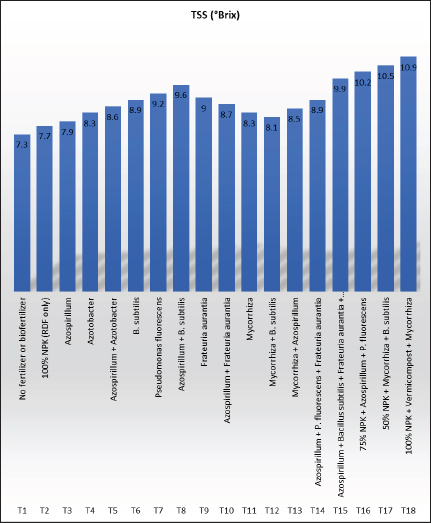 | Figure 3. Effect of biofertilizers and nutrient management treatments on quality (TSS) of beetroot (Beta vulgaris L.). [Click here to view] |
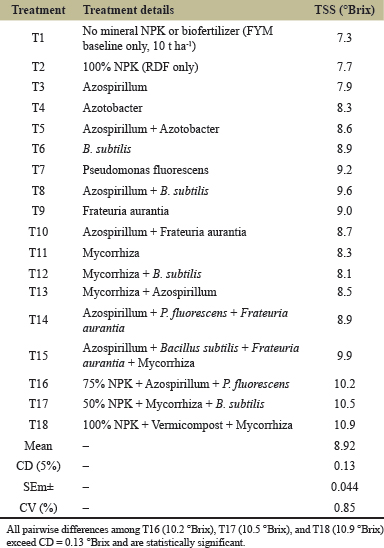 | Table 4. Effect of biofertilizer and nutrient management treatments on quality (TSS) of beetroot (Beta vulgaris L.). [Click here to view] |
The improvement in TSS under T18 is mechanistically linked to balanced macro- and micronutrient availability, promoting higher rates of carbohydrate synthesis and sugar accumulation. Vermicompost supplies humic acids and readily available nutrients that have been associated with enhanced carbohydrate metabolism and sugar accumulation in storage roots [, and AMF enhance carbon allocation to storage organs . These findings corroborate Kondal et al. [13] and Youssef et al. , who reported improved TSS and sugar content in beetroot and root vegetables with vermicompost and mycorrhizal inoculation, respectively.
4. CONCLUSION
The present investigation demonstrates that biofertilizer inoculation combined with varying NPK levels significantly enhances the growth, yield, and quality of beetroot under subtropical conditions. The conclusions drawn in relation to the study objectives are: (1) Responses to biofertilizer and nutrient-management treatments were parameter-dependent, with the integrated treatments T16–T18 generally producing the strongest responses for key growth, yield, and TSS outcomes (2) The combination of 75% NPK with Azospirillum brasilense and Pseudomonas fluorescens (T16) produced the highest root yield in this experiment (24.95 t ha-1; 23.8% over T1 and 21.0% over T2), indicating that partial replacement of inorganic NPK with biofertilizer inoculation can sustain root yield comparable to full NPK fertilisation under the tested combinations (see Section 5, regarding the absence of an NPK-only comparator). Similarly, 50% NPK + Mycorrhiza + Bacillus subtilis (T17) achieved 24.66 t ha-1 (22.4% over T1); And (3) The combination of 100% NPK + vermicompost + mycorrhiza (T18) was the most effective for vegetative growth and TSS quality (10.9 °Brix; 49.3% above T1). T18 is recommended where quality is the primary objective; T16 is recommended where yield maximization with reduced mineral-fertilizer input is the priority. Future studies should employ factorial designs, include NPK-only reduced treatments, measure soil biological indicators, and conduct multi-location trials.
5. LIMITATIONS OF THE STUDY
The non-factorial design limits the separation of individual and interactive treatment effects. No reduced-NPK-only treatment was included, limiting evaluation of the independent biofertilizer contribution. Results are specific to this location and season. Quality evaluation was restricted to TSS. Soil biological properties and nutrient uptake data were not analysed.
6. USE OF ARTIFICIAL INTELLIGENCE (AI)-ASSISTED TECHNOLOGY
The authors used Claude (Anthropic, San Francisco, CA; claude.ai) solely for English language editing, grammar correction, and structural improvement of the manuscript text. Claude was not used to generating, fabricate, or alter research data, statistical analyses, experimental design, or scientific conclusions. All data were collected from the field experiment, and all interpretations and conclusions represent the intellectual work of the authors. The authors confirm that no AI-generated scientific content, data, or fabricated references are present in this manuscript. This disclosure is provided in full transparency in accordance with the journal's policy on the use of AI tools.
7. ACKNOWLEDGEMENTS
The authors sincerely acknowledge the facilities provided by the Department of Horticulture, RSM PG College, Dhampur, affiliated with M.J.P. Rohilkhand University, Bareilly, Uttar Pradesh, India.
8. AUTHORS' CONTRIBUTIONS
All authors made substantial contributions to conception and design, acquisition of data, or analysis and interpretation of data; took part in drafting the article or revising it critically for important intellectual content; agreed to submit to the current journal; gave final approval of the version to be published; and agree to be accountable for all aspects of the work. All the authors are eligible to be authors as per the International Committee of Medical Journal Editors (ICMJE) requirements/guidelines.
9. FUNDING
This research received no specific financial support from public, commercial, or non-profit funding agencies.
10. CONFLICT OF INTEREST
The authors report no financial or any other conflicts of interest in this work.
11. ETHICAL APPROVAL
This study did not involve human or animal subjects; therefore, ethical approval was not required.
12. DATA AVAILABILITY
The data supporting the findings of this study are available from the corresponding author upon reasonable request.
13. PUBLISHER’S NOTE
All claims expressed in this article are solely those of the authors and do not necessarily represent those of the publisher, the editors and the reviewers. This journal remains neutral with regard to jurisdictional claims in published institutional affiliation.
REFERENCES
1. Clifford T, Howatson G, West D, Stevenson E. The potential benefits of red beetroot supplementation in health and disease. Nutrients 2015;7(4):2801–22; CrossRef
2. Ninfali P, Angelino D. Nutritional and functional potential of Beta vulgaris cicla and rubra. Fitoterapia 2013;89:188–99; CrossRef
3. Fageria NK, Baligar VC, Jones CA. Growth and mineral nutrition of field crops. 3rd ed. Boca Raton (FL): CRC Press; 2010. CrossRef
4. Bhardwaj D, Ansari MW, Sahoo RK, Tuteja N. Biofertilizers function as key player in sustainable agriculture by improving soil fertility, plant tolerance and crop productivity. Microb Cell Fact 2014;13:66; CrossRef
5. Vessey JK. Plant growth promoting rhizobacteria as biofertilizers. Plant Soil 2003;255(2):571–86; CrossRef
6. Cassán F, Diaz-Zorita M. Azospirillum sp. in current agriculture: from the laboratory to the field. Soil Biol Biochem 2016;103:117–30; CrossRef
7. Kennedy I. Non-symbiotic bacterial diazotrophs in crop-farming systems: can their potential for plant growth promotion be better exploited? Soil Biol Biochem 2004;36(8):1229–44; CrossRef
8. Gupta G, Parihar SS, Ahirwar NK, Snehi SK, Singh V. Plant growth promoting rhizobacteria (PGPR): current and future prospects for development of sustainable agriculture. J Microbial Biochem Technol 2015;7(2):96–102; CrossRef
9. Çakmakçi R, Dönmez F, Aydin A, Sahin F. Growth promotion of plants by plant growth-promoting rhizobacteria under greenhouse and two different field soil conditions. Soil Biol Biochem 2006;38(6):1482–7; CrossRef
10. Subhashini DV. Growth promotion and increased potassium uptake of tobacco by potassium-mobilizing bacterium Frateuria aurantia grown at different potassium levels in vertisols. Commun Soil Sci Plant Anal 2015;46(2):210–20; CrossRef
11. Smith SE, Read DJ. Mycorrhizal Symbiosis. 3rd ed. London: Academic Press; 2008. CrossRef
12. Ansari AA, Ismail SA. Role of earthworms in vermitechnology. J Agricult Technol 2012;8(2):403–15.
13. Kondal P, Kaur R, Singh N, Maurya V, Sharma A, Kumar R. Effect of organic and inorganic fertilizers on the growth, yield and quality of beetroot (Beta vulgaris L.). Int J Res Agron 2024;7(2):180–6; CrossRef
14. Narula N, Kumar V, Behl RK, Deubel A, Gransee A, Merbach W. Effect of P-solubilizing Azotobacter chroococcum on N, P, K uptake in P-responsive wheat genotypes grown under greenhouse and field conditions. J Plant Nutr Soil Sci 2000;163(4):393–8; CrossRef
15. Kopta T, Pavlíková M, Sekara A, Pokluda R, Maršálek B. Effect of bacterial-algal biostimulant on the yield and internal quality of lettuce (Lactuca sativa L.) produced for spring and summer harvest. Notulae Botanicae Horti Agrobotanici Cluj-Napoca 2018;46(2):615–21; CrossRef
16. Jackson ML. Soil chemical analysis. Prentice Hall of India Pvt. Ltd, New Delhi, India, 1973;106-203. Available Online: https://www.scirp.org/reference/referencespapers?referenceid=2511222
17. Subbiah BV, Asija GL. A rapid procedure for the estimation of available nitrogen in soils. Curr Sci 1956;25(8):259–60.
18. Bray RH, Kurtz LT. Determination of total, organic, and available forms of phosphorus in soils. Soil Sci 1945;59(1):39–45; CrossRef
19. Anonymous. Package of practices for vegetable crops. Uttar Pradesh Council of Agricultural Research, Lucknow, India, 2020.
20. AOAC. Official Methods of Analysis. 17th ed. Gaithersburg, MD: Association of Official Analytical Chemists; 2000.
21. Gomez KA, Gomez AA. Statistical Procedures for Agricultural Research. 2nd ed. John Wiley & Sons, New York, NY, 1984.
22. Tejada M, Hernandez M, Garcia C. Soil restoration using composted plant residues: effects on soil properties. Soil Tillage Res 2009;102(1):109–17; CrossRef
23. Maloisane RM, Kayombo B. Evaluation of vermicompost on development and yield of beetroot (Beta vulgaris). World J Adv Eng Technol Sci 2022;7(1):001–8; CrossRef
24. Youssef AA, Badawi MH, Abdelhadi AA, Elashry A, Badr AA, Hussein GMH. Impact of mycorrhizal symbiosis on nutrient use efficiency, plant growth, and soil microbiome dynamics in sugar beet. Sugar Tech 2026;28:1339–51; CrossRef
25. Rajput T, Singh A. Effect of Pseudomonas fluorescens on root yield and quality in carrot under integrated nutrient management. Agricult Sci 2020;11(4):235–42; CrossRef