
Editorial
The soil ecology has negatively impacted by the overuse of chemical fertilizers worldwide, which goes beyond crop and soil threshold limitations. Thus, by employing soil microbes as a source of fertilizers, farmers are currently transitioning from agrochemical to agro-biotechnological methods. For the past few decades, soil microbial populations have been viewed as the key component of sustainable farming techniques in industrialized nations. In addition to maintaining biogeochemical cycles and the general climatic balance of the Earth system, research has unequivocally demonstrated the critical role that interactions and activities of soil microorganisms play in promoting plant growth, improving soil health, and sustaining agricultural productivity. Beneficial microbial strains, such as bacteria, fungi, and algae that are integrated into appropriate carrier materials to enable their application and mobilization in the soil, are referred to as biofertilizers. It mineralizes the organic materials in the soil and fixes nitrogen from the atmosphere. Inoculants for biofertilizers might be unique to a single species or a mixture of many strains that are compatible. The symbiotic relationships between two or more compatible microbial strains are known as microbial consortia. Compared to single-strain inoculants, a microbial consortium significantly increases crop and soil productivity under high stress. Thus, the greatest way to establish sustainable agriculture practices globally is through consortia and microbial fertilizers.
All other living forms have been made possible by the basic shaping of the planet caused by the birth of microbes more than 3 billion years ago. Microorganisms are thought to account for more than 99% of all species on Earth today, making them the most varied organisms [1]. They can be found in nearly every setting, including human stomachs and deep ocean trenches. Microbes play a crucial role in the cycling of most of the key elements that are necessary for life on Earth because of their special catalytic ability [2]. Microbes are essential to the planetary system's operation, much as the human microbiome is to an individual's well-being [3].
The Sustainable Development Goals were developed following the Rio+20 United Nations Conference on Sustainable Development and were formally adopted by all United Nations Member States in 2015 as part of the 2030 Agenda for Sustainable Development, providing a comprehensive framework for advancing global sustainability [4]. However, despite the fact that microbial activity is essential to all life, the high-level policy documents intended to accomplish these objectives do not specifically address the function of microbes [5].
Nonetheless, a growing body of research demonstrates how distinct microbial groups carry out distinct tasks, and the efficient management of microbial communities can provide answers for enhancing a variety of facets of life, from food or energy production to human health [6]. Furthermore, addressing global problems, including pandemic breakouts, food instability, biodiversity loss, disease emergence, climate change, and growing social inequality, can be aided by enhancing microbial health [7]. However, only a small number of financial and regulatory frameworks have acknowledged the significance of funding focused microbial research required to meet global sustainability targets or providing incentives for the adoption of microbial-based solutions [8].
One of nature's greatest and delicately balanced processes is the interaction of species, and plant–microbe interactions provide a particularly striking illustration of this ecological harmony. Plants form relationships with a variety of microorganisms during their life cycle, including bacteria, fungi, actinomycetes, and algae [9]. Most of these relationships are mutually helpful, while they can also be neutral, harmful, or beneficial. In these kinds of partnerships, microorganisms benefit from the shelter, carbon sources, and vital nutrients that plants offer, while plants benefit from the microbes' improved growth, development, and survival [10]. A wide range of bioactive substances is produced by plant-associated microorganisms, and these substances enhance nutrient uptake, control plant metabolism, and increase resistance to biotic (pathogens and pests) and abiotic (drought, salinity, and heavy metals) stresses [11]. These microorganisms inhabit certain ecological niches, such as the rhizospheric zone around the roots, aerial plant surfaces (epiphytic areas), and inside plant tissues (endophytic or apoplastic regions). Each of these niches supports unique microbial populations with specialized roles [12].
Microbes provide beneficial characteristics that control plant development, enhance soil nutrient availability, and offer defense against stressful situations. These characteristics prompted extensive research and commercialization of microbial strains. Nonetheless, the structure and makeup of microorganisms were critical to the overall improvement of beneficial activities in any niche region. Because microbial consortia contain a variety of plant growth promotion traits and biocontrol mechanisms, they can function at a higher level than single strains when they combine synergistically [13,14]. These microbial consortia enhance nitrogen uptake efficiency and mitigate the adverse effects of salinity and drought stress, thereby improving plant growth and productivity under challenging environmental conditions. Others, such as N-fixations and nitrogen absorption, are essential for preserving soil health outside of traditional agricultural production techniques. First measures must be taken before creating a microbial consortium. This indicates that the host plant in issue is either directly or indirectly impacted by the microorganisms' compatibility and co-occlusion. In addition to germination, nutrient absorption, plant height, number of branches, tuber formation, yield, and total crop biomass, inoculation in conjunction with beneficial microbes demonstrated increased plant development and yield characteristics. The recommendations made by the collaboration enhance microorganisms’ dependability, efficiency, and consistency in a range of soil conditions (Fig. 1). It is believed that the consortium's mix of biocontrol agents offers a greater degree of protection and may be able to manage certain plant diseases [13].
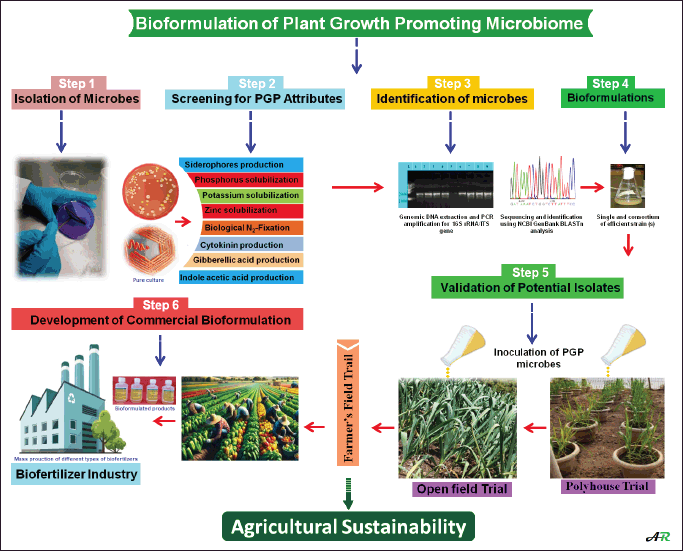 | Figure 1. Microbial bioformulation strategies for development of novel biofertilizers. Adopted from Negi et al. [28]. [Click here to view] |
The most crucial factor is establishing the quality of biofertilizers prior to commercialization; thus, rigorous work must be done at every stage of manufacture. While the norms and regulations of quality control are well established in countries where sustainable agriculture techniques are used [15], the concentration of the microbial strains utilized is regarded as the most significant of the eight characteristics that constitute quality control. The water and carbon content, carrier size, microbial load, expiration term, appearance, and contamination are the eight criteria. For bacterial-based liquid biofertilizer formulations, the microbial content should range between >0.5 × 10⁹ and >1.51 × 10⁹ CFU ml-1, whereas in solid formulations it should range between >0.1 × 10⁹ and >0.3 × 10⁹ CFU g-1. In addition, approved quality standards recommend a total organic load of 18%–20%, irrespective of formulation type, with a minimum shelf life of 6 months [16]. Bioinoculants can be administered directly or indirectly to leaves, seeds, soil, and seedlings. Depending on factors such as crop variety, inoculants utilized, environmental circumstances, and certain technical issues from farmers' perspectives, each sort of method has advantages and disadvantages [17].
Biofertilizers cannot be used indiscriminately, but rather must be used with appropriate precautions. Biofertilizer solution should not be kept overnight, stored in the range of 0°C–35°C, and should be away from direct sunlight [18]. The seed treatment strategy is the most widely adopted method for biofertilizer application as it does not require much inoculation product and is easy to perform. Biofertilizers may be administered to seeds in three different ways: slurry, seed coating, and dusting [19]. Dusting involves mixing the biofertilizers with the dry seeds, this method is not very successful since there is little contact between the biofertilizer bacteria and the seed. Either the wet seeds or the seeds can be placed in the slurry for the whole night with the addition of bioinoculants [19,20]. In another method, microbes are added to the seed slurry or suspension, and then the outer layer of additional inorganic inert materials, such as charcoal, lime, talc, dolomite, and clay are applied to the seed inside the slurry [21]. This outer covering of inert materials protects the seeds from the harmful effects of chemical pesticides and fertilizers and any unfavorable environment. The bacterial groups involved in seed treatment procedures include Rhizobium, Azospirillum, PSM, Azotobacter, and possibly a consortium of microbes [22]. If there is a significant number of microbiomes to be directly injected into the soil area, a soil inoculation procedure is essential. This method of inoculation of soil is dominated by granular soil aggregates, peat, talcum powder, and perlite that have a granule size range of 0.5–1.5 mm [23]. The soil treatment process also protects the microbial fertilizer strains from the adverse effects of fungicides and pesticides and prevents the destruction of the seed coatings and loss of biofertilizers during seeding machine operations [24]. The soil inoculation method is a parallel procedure to seed treatment method, which raises the chances of seed-biofertilizer interaction. However, there are some technical challenges that arise here like special tools are required and biofertilizers need to be stored and transported in huge quantities. In the industrialized world, soil inoculation is frequently carried out in the form of granules [25].
The industrialized countries adhere to stringent guidelines and rules regarding the use of the microbial consortium. The first stage in commercializing a product is to successfully register it, which requires that it fulfil the guidelines' particular requirements. The microbial consortium formulation must include an appropriate carrier, such as charcoal or alginate, before registration so that the microbial cells may adhere to the seeds during planting [26]. Microbial consortia are either sprayed on the seeds before sowing or scattered in the seed furrows in the liquid formulation. The product lifespan and storage can guarantee the microbial strains' survival, biological activity, and viability. The acute and chronic uses of the microbial community should be clearly understood [27]. For instance, in short-term or acute applications, microbial consortia are applied for a limited duration, allowing them to target specific stages of crop growth, particularly under conditions of abiotic stress. The microbial consortium is sprayed on a regular basis or released slowly using the seed treatment approach, which is unlikely in long-term usage [28]. In the United States, regulatory frameworks governing microbial consortia remain insufficiently defined. Given the significant potential for agronomic advancement in Asian and African countries, along with the large workforce engaged in agricultural activities, there is a pressing need to establish globally harmonized standards, protocols, and characterization guidelines for microbial consortia [29].
Microbial consortia represent a powerful and sustainable strategy for enhancing agricultural productivity while preserving environmental integrity. They improve soil fertility, boost plant development, encourage nutrient cycling, and boost resistance to biotic and abiotic stressors by bringing together functionally diverse microorganisms. Compared to single-strain inoculants, their synergistic interactions allow for more effective resource use, making them a possible substitute for chemical-based inputs. Nevertheless, there are a number of obstacles to the broad use of microbial consortia. Field-level discrepancies, a lack of knowledge about microbial interactions, and problems with formulation stability and shelf life continue to be major obstacles. Additionally, their commercialization and adoption among farmers are limited by the lack of established quality control procedures and unified global regulatory frameworks. The combination of cutting-edge technologies such as systems biology, metagenomics, and genomics to create resilient and focused microbial consortia holds promise for the future. These methods can aid in the comprehension of environmental adaptation, functional dynamics, and microbiological compatibility. Large-scale adoption requires strengthening policy backing, creating uniform standards, and raising farmer knowledge. Microbial consortia have the potential to significantly contribute to the worldwide advancement of resilient and sustainable agriculture systems with further study and innovation.
REFERENCES
1. Falkowski PG. Life's engines: how microbes made earth habitable. Princeton University Press, Chocago, IL, p 224, 2023.
2. Yadav N, Singh N, Srivastava S. Role of micro-organisms in nutrient cycle and management of ecosystems. In: Gupta J, Verma A (eds.). Green equilibrium: deciphering earth's ecosystems for sustainable tomorrow, Springer, p 327, 2025; CrossRef
3. Handte-Reinecker A, Sardeshpande M. Microbiomes as modulators of human and planetary health: a relational and cross-scale perspective. Glob Chang Biol 2025;31:e70152; CrossRef
4. Lee BX, Kjaerulf F, Turner S, Cohen L, Donnelly PD, Muggah R, et al. Transforming our world: implementing the 2030 Agenda through sustainable development goal indicators. J Public Health Policy 2016;37:13–31; CrossRef
5. Crowther TW, Rappuoli R, Corinaldesi C, Danovaro R, Donohue TJ, Huisman J, et al. Scientists’ call to action: microbes, planetary health, and the sustainable development goals. Cell 2024;187:5195–216; CrossRef
6. Suman J, Rakshit A, Ogireddy SD, Singh S, Gupta C, Chandrakala J. Microbiome as a key player in sustainable agriculture and human health. Front Soil Sci 2022;2:821589; CrossRef
7. Callens K, Fontaine F, Sanz Y, Bogdanski A, D‘Hondt K, Lange L, et al. Microbiome-based solutions to address new and existing threats to food security, nutrition, health and agrifood systems' sustainability. Front Sustain Food Syst 2022;6:1047765; CrossRef
8. Sundh I, Del Giudice T, Cembalo L. Reaping the benefits of microorganisms in cropping systems: is the regulatory policy adequate?. Microorganisms 2021;9:1437; CrossRef
9. Nadarajah K, Abdul Rahman NSN. The microbial connection to sustainable agriculture. Plants 2023;12:2307; CrossRef
10. Harman G, Khadka R, Doni F, Uphoff N. Benefits to plant health and productivity from enhancing plant microbial symbionts. Front Plant Sci 2021;11:610065; CrossRef
11. Koza N, Adedayo A, Babalola O, Kappo A. Microorganisms in plant growth and development: roles in abiotic stress tolerance and secondary metabolites secretion. Microorganisms 2022;10:1528; CrossRef
12. Butani N, Desai P, Trivedi S. Epiphytic microbes of roots: diversity and Significance. In: Nath M, Bhatt D, Bhargava P, Choudhary DK (eds.). Microbial metatranscriptomics belowground, Springer, p 367, 2021; CrossRef
13. Negi R, Sharma B, Parastesh F, Kaur S, Khan SS, Kour D, et al. Microbial consortia mediated regulation of plant defense: a promising tool for sustaining crops protection. Physiol Mol Plant Pathol 2024;134:102393; CrossRef
14. Negi R, Sharma B, Jan T, Kaur T, Chowdhury S, Kapoor M, et al. Microbial consortia: promising tool as plant bioinoculants for agricultural sustainability. Curr Microbiol 2024;81:222.
15. Sundaramoorthy S, Jaiganesh V. Policies, regulations and quality assurance requirements for sustainable agriculture. In: Sundaramoorthy S, Jaiganesh V (eds.). Molecular approaches for the detection of fungal phytopathogens, CRC Press, p 233, 2025; CrossRef
16. Gehlot P, Pareek N, Vivekanand V. Development of biofertilizers and microbial consortium an approach to sustainable agriculture practices. In: Dubey SK, Verma SK (eds.). Plant, soil and microbes in tropical ecosystems. Springer Singapore, Singapore, p 315, 2021; CrossRef
17. O'Callaghan M, Ballard RA, Wright D. Soil microbial inoculants for sustainable agriculture: limitations and opportunities. Soil Use Manage 2022;38:1340–69.
18. Aloo BN, Mbega ER, Makumba BA, Tumuhairwe JB. Effects of carrier materials and storage temperatures on the viability and stability of three biofertilizer inoculants obtained from potato (Solanumtuberosum L.) rhizosphere. Agriculture 2022;12:140; CrossRef
19. Sahu P, Brahmaprakash G. Formulations of biofertilizers – approaches and advances. In: Singh D, Singh H, Prabha R (eds.). Microbial inoculants in sustainable agricultural productivity, Springer, p 179, 2016; CrossRef
20. Allouzi MMA, Allouzi SMA, Keng ZX, Supramaniam CV, Singh A, Chong S. Liquid biofertilizers as a sustainable solution for agriculture. Heliyon 2022;8; CrossRef
21. Rocha I, Ma Y, Souza-Alonso P, Vosátka M, Freitas H, Oliveira RS. Seed coating: a tool for delivering beneficial microbes to agricultural crops. Front Plant Sci 2019;10:1357; CrossRef
22. Muthusamy Y, Sengodan K, Arthanari M, Kandhasamy R, Gobianand K. Biofertilizer and consortium development: an updated review. Curr Agric Res J 2023;11:01–17.
23. Haynes RJ, Zhou YF, Weng X. Formulation and use of manufactured soils: a major use for organic and inorganic wastes. Crit Rev Environ Sci Technol 2022;52:4113–33; CrossRef
24. Afzal I, Javed T, Amirkhani M, Taylor AG. Modern seed technology: seed coating delivery systems for enhancing seed and crop performance. Agriculture 2020;10:526; CrossRef
25. Narayana S, Jagetiya P, Mathur R, Mishra R, Chauhan S. Biofertilizer Commercialization: future prospects and challenges. Agric Res J 2025;62:1–5; CrossRef
26. Khan A, Singh AV, Gautam SS, Agarwal A, Punetha A, Upadhayay VK, et al. Microbial bioformulation: a microbial assisted biostimulating fertilization technique for sustainable agriculture. Front Plant Sci 2023;14:1270039; CrossRef
27. Chaudhary T, Dixit M, Gera R, Shukla AK, Prakash A, Gupta G, et al. Techniques for improving formulations of bioinoculants. 3 Biotech 2020;10:199; CrossRef
28. Negi R, Yadav N, Yadav AN. Microbial biofertilizers: a paradigm shift towards agricultural sustainability. Biologia 2025;80:389–414; CrossRef
29. Nuti M, Ercoli L, Pellegrino E. The bacterial-fungal consortia: farmer’s needs, legal and scientific opportunities, and constraints. In: Maheshwari DK, Dheeman S (eds.). Sustainable agrobiology: design and development of microbial consortia, Springer, Singapore, p 109, 2023; CrossRef