
1. INTRODUCTION
Carbon dioxide (CO2) plays a fundamental role in plant physiology by regulating photosynthesis, carbon metabolism, and cellular homeostasis. In postharvest systems, elevated CO2 (eCO2) is widely employed in controlled-atmosphere (CA) storage and modified-atmosphere packaging (MAP) to suppress respiration, delay senescence, reduce microbial growth, and preserve the quality of fresh fruits and vegetables. In addition to these physiological effects, increasing evidence indicates that eCO2 influences antioxidant metabolism and cellular redox balance. A meta-analysis involving multiple vegetable species reported significant increases in ascorbic acid, phenolic compounds, flavonoids, and total antioxidant capacity under eCO2 conditions [1]. Similarly, studies in horticultural crops such as strawberry and tomato have demonstrated that CO2 exposure modifies antioxidant enzyme activities and redox-related metabolites [2,3]. However, these studies have largely examined prolonged or continuous CO2 exposure, whereas the immediate physiological and biochemical responses to short-term CO2 treatment in whole fruits remain poorly understood.
Amla (Phyllanthus emblica L.), commonly known as Indian gooseberry, is an economically important fruit valued for its exceptionally high ascorbic acid content and diverse bioactive phytochemicals. The fruit is rich in gallic acid, ellagic acid, hydrolysable tannins, and other phenolic compounds that contribute to its remarkable antioxidant capacity and therapeutic properties [4,5]. Consequently, amla has gained considerable importance in the food, nutraceutical, and pharmaceutical industries [6]. Despite its nutritional significance, fresh amla is highly perishable and undergoes rapid physiological deterioration after harvest. Moisture loss, tissue softening, progressive losses in ascorbic acid and antioxidant capacity, changes in colour and tissue structure, and oxidative stress contribute to postharvest losses estimated to reach one-third of the harvested crop [7]. Under ambient storage conditions, the fruit generally remains marketable for only 5–6 days, during which physiological loss in weight increases while firmness, titratable acidity, and ascorbic acid content progressively decline [8–10].
To extend storage life, several postharvest technologies have been investigated for amla, including low-temperature storage, low-density polyethylene packaging, MAP, edible coatings, and other postharvest treatments [11–13]. Among these approaches, eCO2 has attracted considerable attention because of its ability to retard senescence, suppress respiration, reduce physiological disorders, and maintain fruit quality during storage [14,15]. Beyond these beneficial effects, eCO2 has also been associated with changes in antioxidant metabolism and cellular redox status [16–18], suggesting that CO2 may function as a physiological signal capable of activating stress-responsive metabolic pathways [19]. Since cellular signalling events generally precede long-term metabolic adaptations, understanding the early responses induced by CO2 exposure may provide valuable insight into the mechanisms underlying postharvest quality preservation [20].
In commercial postharvest handling, fruits are frequently subjected to transient exposure to eCO2 during gas flushing, establishment of CA conditions, MAP, transportation, and storage transitions [21,22]. Although these exposures are relatively brief, they may be sufficient to initiate rapid physiological and biochemical responses before longer term acclimation occurs [19,23,24]. Nevertheless, little information is available regarding the immediate effects of short-duration CO2 exposure on antioxidant metabolism in fresh produce [17], particularly in amla. To date, studies on eCO2 have predominantly focused on prolonged storage or continuous atmospheric enrichment [19,23], while the biochemical responses occurring within minutes of CO2 exposure remain largely unexplored [20].
We hypothesize that brief exposure to eCO2 acts as a mild abiotic stimulus that could induce rapid antioxidant responses and stimulate ascorbic acid accumulation through transient oxidative signalling without causing significant physicochemical deterioration of amla fruit. Since oxidative deterioration in amla is characterized by the decline of ascorbic acid, antioxidant capacity, tissue firmness, and overall fruit quality, these parameters were selected to evaluate the early physiological response to CO2 exposure. Therefore, the objective of the present study was to investigate the immediate physiological and biochemical responses of amla fruit following short-duration (5–15 minutes) CO2 exposure. This study provides new insight into the instantaneous biochemical responses of amla fruit to transient eCO2 exposure.
2. MATERIALS AND METHODS
2.1. Sample Preparation
Commercially mature amla (P. emblica L.) fruits (Neelam cultivar) were purchased from a local fruit market in Yendada, Visakhapatnam, Andhra Pradesh, India, and stored at room temperature (29°C–30°C) until further processing. They were subjected to surface decontamination using a 1% (w/v) sodium hypochlorite solution, followed by sequential rinsing with sterile deionized water and ambient air-drying. Atmospheric CO2 treatments were conducted within a hermetically sealed, custom-engineered expanded polystyrene chamber (20 × 20 × 15 cm) at room temperature. The system was equipped with a gas inlet port coupled to a medical-grade CO2 cylinder and monitored via a calibrated portable infrared gas analyser. Throughout the experimental duration, a constant CO2 partial pressure of 5 kPa was maintained. Whole fruits were treated with CO2 for transient intervals of 5, 10, and 15 minutes. These short exposure durations were selected to evaluate immediate biochemical responses to CO2 treatment. Following each exposure, the fruits were immediately processed by removing the seeds and isolating the mesocarp (pulp) tissue for biochemical characterization. Control fruits were maintained under identical conditions within the sealed chamber under ambient atmospheric CO2 (~0.04 kPa).
2.2. Microscopic Examination
To evaluate the impact of transient exposure on cellular architecture, thin transverse sections of the amla mesocarp were prepared via manual microtomy using a sterilized surgical blade. The sections were subjected to histological staining with Eosin Y (0.5% w/v), and excess dye was removed through sequential rinsing with distilled water. Microscopic characterization was performed using a Magnus MLX Plus LED light microscope at 10× and 40× optical magnifications.
2.3. Estimation of Ascorbic Acid (Vitamin C)
Fresh mesocarp tissue was homogenized to a fine pulp. The resulting homogenate was filtered, and the filtrate was brought to a final volume of 100 ml using 4% (w/v) oxalic acid. For the assay, 5 ml aliquots of the diluted sample were acidified with 10 ml of 4% oxalic acid and titrated against a freshly prepared 2,6-dichlorophenolindophenol solution. The titration was conducted until the achievement of a persistent light pink endpoint (lasting ≥15 seconds). A primary standard of L-ascorbic acid (1 mg/ml in 4% oxalic acid) was utilized to calibrate the reagent and determine the dye factor (mg of ascorbate equivalent to 1 ml of dye). Ascorbic acid was expressed as mg/100 g fresh weight (FW) and calculated using:

Where D is the dye factor (mg ascorbic acid/ml dye), V is the titre value of sample (ml), DF is the dilution factor, A is the aliquot volume analysed (ml), W is the sample weight (g) [25].
2.4. Total Phenolic Content
Total phenolic content (TPC) was estimated using the Folin–Ciocalteu colorimetric assay with minor modifications. Fresh mesocarp tissue was homogenized and extracted in methanol at a 1:10 (w/v) ratio for 1 hour at ambient temperature. The resulting homogenate was filtered to obtain a clarified methanolic extract. A 1 ml aliquot of this extract was combined with 1 ml Folin–Ciocalteu reagent. After an equilibration period of 5 minutes, the mixture was neutralized by the addition of 2 ml of 2.5% (w/v) sodium carbonate (Na2CO3). After 120 minutes of dark incubation at room temperature, absorbance was measured at 760 nm using a UH5300 spectrophotometer. A standard calibration curve was generated using gallic acid concentrations (10–100 µg/ml), and the results were expressed as milligrams of gallic acid equivalents per gram of FW (mg GAE/g FW). TPC was calculated using the following formula:
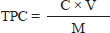
where C (mg/ml) = phenolic concentration, which was obtained from the standard curve graph, V (ml) = volume of the extract, and M (g) = mass of the sample [26].
2.5. Total Carbohydrate Content
Fresh mesocarp tissue (1 g) was homogenized and subjected to acid hydrolysis using 2.5 N hydrochloric acid (5 ml) in a boiling water bath for 3 hours. Following hydrolysis, the reaction mixture was cooled to ambient temperature and carefully neutralized with Na2CO3 [2.5% (w/v) Na2CO3] until effervescence ceased. The hydrolysate was filtered, and the filtrate was brought to a final volume of 100 ml with distilled water. For the colorimetric assay, 1 ml of 5% (w/v) phenol solution and 5 ml of concentrated sulfuric acid (98%) were added to 1 ml of the filtrate and incubated at ambient temperature in the dark for 10 minutes, followed by a secondary incubation at 30°C for 20 minutes. Absorbance was measured at 490 nm using a UH5300 spectrophotometer. A standard calibration curve was constructed using D-glucose concentrations ranging from 0 to 100 µg/ml, and results were expressed as a percentage (%) on a FW basis [27].
2.6. 2,2-Diphenyl-1-Picrylhydrazyl Radical Scavenging Assay
Fresh mesocarp tissue was macerated in absolute methanol at a 1:10 (w/v) ratio and filtered. Methanolic extract (5 ml) was combined with 1 ml of 0.3 mM 2,2-diphenyl-1-picrylhydrazyl (DPPH) solution prepared in methanol. The reaction mixture was incubated in the dark at ambient temperature for 30 minutes, and absorbance was measured at 518 nm using a UH5300 spectrophotometer. The percentage of DPPH radical scavenging activity (SA%) was calculated using the following equation:

Where Acontrol = absorbance values of the control (DPPH plus solvent without sample extract) and Asample = absorbance values of the samples [26].
2.7. Estimation of Hydrogen Peroxide
Fresh tissue (0.5 g) was homogenized in 5 ml of ice-cold 0.1% (w/v) trichloroacetic acid using a pre-chilled mortar and pestle. The homogenate was centrifuged at 10,000 × g (4°C) for 10 minutes to isolate the clarified supernatant. For the analytical reaction, 0.5 ml of the supernatant was combined with 0.5 ml of 10 mM potassium phosphate buffer (pH 7.0) and 1 ml of 1 M KI. Following a 10-min incubation in darkness, the absorbance was recorded at 390 nm using a UH5300 spectrophotometer. Concentrations were quantified using a standard calibration curve of reagent-grade hydrogen peroxide (H2O2) and expressed as µmol/g FW [28].
2.8. Ascorbate Peroxidase Activity Assay
Fresh mesocarp tissue (0.5 g) was homogenized in 5 ml of ice-cold 50 mM potassium phosphate buffer (pH 7.0) supplemented with 0.1 mM Ethylenediaminetetraacetic acid (EDTA). The homogenate was centrifuged at 12,000 × g (4°C) for 15 minutes. The assay was performed using 0.1 mM H2O2 in a 3 ml reaction volume consisting of 50 mM potassium phosphate buffer (pH 7.0), 0.5 mM L-ascorbate, 0.1 mM EDTA, and 0.1 ml of the protein extract. The enzymatic rate was quantified by measuring the decrease in absorbance at 290 nm for 1 minute, which corresponds to the stoichiometric consumption of the ascorbate substrate (ε = 2.8 mM-1 cm-1). One unit of ascorbate peroxidase (APX) activity was defined as the amount of enzyme required to oxidize 1 µmol of ascorbate per min (expressed as µmol ascorbate oxidized min/g FW) [29].
2.9. pH
Following the standard protocol of the Food Safety and Standards Authority of India [30], 10 g of fruit pulp was accurately weighed and dispersed in 100 ml of distilled water. The mixture was then pulverized and filtered to obtain a clear extract and maintained at 28?C while measuring pH using a calibrated digital pH meter (Adwa AD1000 pH/mV).
2.10. Moisture Analysis
The moisture content of the fruit samples was determined using a Radwag MA 50/1. R.WH halogen moisture analyser. For each analysis, ~3 g of the sample was distributed evenly on the sample pan to ensure uniform heat exposure. The determination was conducted at a drying temperature of 99°C until a consistent weight was achieved.
2.11. Fourier Transform Infrared Analysis
Samples were macerated at a 1:10 ratio (w/v) for 2 hours at room temperature, and then filtered to prepare clear extracts for analysis. The spectral data were recorded using a Bruker Alpha II ATR-FT-IR spectrometer equipped with a zinc selenide Attenuated Total Reflectance crystal. Spectra were collected over the range of 4,000–500 cm–¹, at a resolution of 4 cm–¹ by averaging 32 scans for each sample.
2.12. Commission Internationale de l'Éclairage (CIELAB) Colour Analysis
Fruit was sliced into uniform sections (~5 mm thick) to ensure a flat surface for measurement. Colour coordinates were recorded using a Hunterlab ColorFlex EZ colorimeter, calibrated and operated under standard illuminant D65 and a 10° standard observer. Measurements were taken at three randomly selected points on each slice, and the mean values were calculated for further analysis. The total colour difference (ΔEab) between the control and eCO2-treated samples was calculated using the following equation:

here, L1*, a1* and b1* indicate the colour values of the control, while L2*, a2* and b2* indicate the colour values of the CO2-treated samples.
2.13. Multivariate Statistical Analysis
The experiment consisted of four treatments with three independent biological replicates per treatment. Each biological replicate comprised three fruits processed together under identical treatment conditions. Data are presented as the mean ± SD. Statistical analyses were performed using XLSTAT (Addinsoft, Paris, France), integrated with Microsoft Excel (MS Office 2021). Differences among treatments were evaluated using one-way analysis of variance (ANOVA), followed by Tukey’s honestly significant difference (HSD) post hoc test for multiple comparisons. Statistical significance was established at p < 0.05.
For multivariate analysis, for each treatment, individual replicate values of all measured physicochemical and biochemical variables, including ascorbic acid content, TPC, DPPH radical scavenging activity, H2O2 content, APX activity, moisture content, pH, colour parameters, and other measured quality attributes, were subjected to Z-score standardization. Standardization centred the data to a mean of zero and scaled them to unit variance to ensure equal weighting of all variables.
The standardized dataset consisting of four observations (control, 5, 10, and 15 minutes CO2 treatments) and the corresponding measured variables was used for heat-map visualization and Pearson correlation analysis. Principal component analysis (PCA) was performed using the same standardized data matrix in XLSTAT to reduce dimensionality and visualize relationships among treatments and variables. PCA score plots were used to assess patterns among treatments, while loading plots were used to evaluate the contribution of individual variables to the principal components.
3. RESULTS AND DISCUSSION
3.1. Microscopic Structural Response of Amla Tissue to Short-term CO2 Exposure
Microscopic analysis was performed to evaluate early cellular alterations induced by short-term CO2 exposure. Microscopic examination of control samples revealed normal parenchymal cell morphology with well-defined cell boundaries and uniform cytoplasmic distribution (Fig. 1). In contrast, CO2-treated samples exhibited noticeable cellular swelling, which may be associated with rapid gas diffusion and transient osmotic adjustments within the tissue matrix. Unlike oxygen, CO2 can diffuse efficiently through both intercellular spaces and the intracellular liquid phase, enabling rapid interaction with the cellular environment [31]. eCO2 treatments have been reported in other horticultural commodities to help maintain cell wall–plasma membrane association, preserve membrane integrity, and reduce structural deterioration during postharvest storage, thereby contributing to improved tissue quality [32].
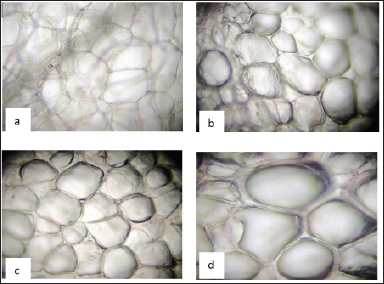 | Figure 1. Microscope images of amla tissue at 40 × magnification under a light microscope. Representative light micrographs of transverse sections of amla (Phyllanthus emblica L.) fruit following short-term CO2 exposure (control, 5, 10, and 15 minutes). Images were acquired using a light microscope at 40× magnification. The micrographs illustrate general tissue organization. a, Control; b, 5 minutes exposure; c. 10 minutes exposure; d, 15 minutes exposure. [Click here to view] |
3.2. Effect of CO2 Exposure on Ascorbic Acid Content
Short-duration exposure to eCO2 significantly increased the ascorbic acid content of amla samples (Fig. 2a). Mean vitamin C content increased progressively from 370.83 ± 1.54 mg/100 g in the control to 427.23 ± 1.52, 439.02 ± 1.01, and 458.00 ± 2.04 mg/100 g following 5, 10, and 15 minutes of CO2 exposure, respectively. One-way ANOVA showed a highly significant effect of CO2 treatment on ascorbic acid levels (F = 1693.42, p = 1.5 × 10⁻¹¹), while Tukey’s HSD test confirmed significant differences among treatment groups, demonstrating a positive exposure-time-dependent increase in ascorbic acid content within the investigated range. The progressive reduction in the rate of increase at longer exposure durations indicates a transient metabolic response that may reflect an equilibrium between biosynthesis, utilization, and antioxidant regulation under short-term CO2 stress [23,33–35].
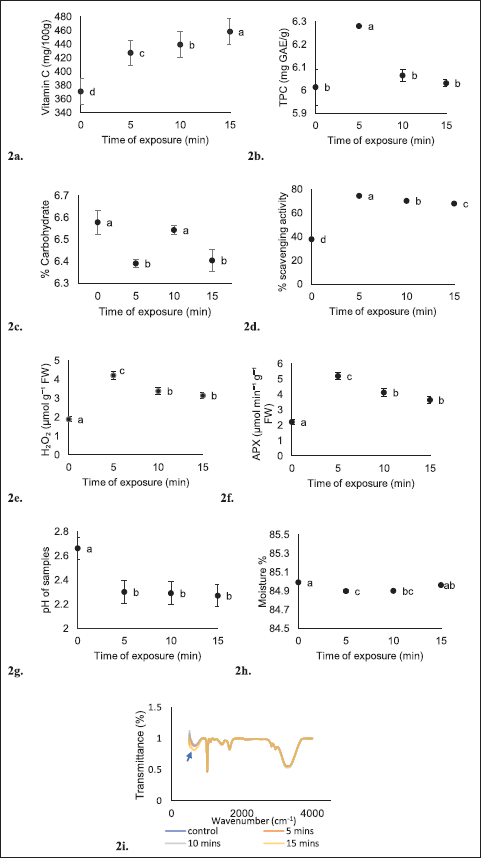 | Figure 2. Measures of physicochemical parameters to quantify the effect of CO2 exposure. Effect of short-term CO2 exposure (control, 5, 10, and 15 minutes) on various physicochemical and biochemical parameters of amla (Phyllanthus emblica L.) fruits. Data are presented as the mean (n = 3), and error bars represent the SD. Different lowercase letters indicate significant differences among treatments according to one-way ANOVA followed by Tukey’s HSD test at p < 0.05. a, Ascorbic acid content; b, TPC; c, TCC; d, scavenging activity; e, H2O2 content; f, APX activity; g, pH values; h, moisture content; 2i, FT-IR spectra (4,000–500 cm-1) of control (0 minutes) and CO2-treated samples following 5, 10, and 15 minutes exposure. [Click here to view] |
3.3. Effect of CO2 Exposure on TPC
The TPC of amla exhibited a transient increase following short-term CO2 exposure (Fig. 2b). Control samples showed a baseline TPC of ~6.01 mg GAE/g. After 5 minutes of exposure, TPC increased to 6.28 mg GAE/g. However, with longer exposure durations, phenolic levels gradually declined toward baseline values, reaching 6.07 mg GAE/g at 10 minutes and 6.03 mg GAE/g at 15 minutes. The initial increase in TPC suggests activation of stress-responsive phenolic metabolism under short-term CO2 exposure [36,37]. Similar increases in phenolic accumulation under eCO2 conditions have been reported in several fruit systems [38,39]. The gradual decline observed at longer exposure durations may indicate partial metabolic adjustment or utilization of phenolic compounds during the maintenance of cellular stability under continued gas exposure [39,40].
3.4. Effect of CO2 Exposure on Total Carbohydrate Content
Total carbohydrate content (TCC) in amla exhibited a transient decline followed by partial recovery during short-term CO2 exposure (Fig. 2c). Control samples showed a baseline carbohydrate content of 6.577%. After 5 minutes of exposure, carbohydrate levels decreased significantly to 6.389%. With increasing exposure duration, carbohydrate content partially recovered to ~6.54% at 10 minutes and stabilized at 6.41% after 15 minutes. Similar transient alterations in sugar metabolism under eCO2 conditions have been reported in other horticultural products, including strawberries, where short-term CO2 exposure influenced glucose, fructose, and sucrose accumulation [23].
3.5. Effect of CO2 exposure on antioxidant scavenging activity
Amla fruit possesses a strong natural antioxidant system comprising ascorbic acid, phenolic compounds, and other antioxidant metabolites that contribute to its radical scavenging capacity [4,41]. In the present study, the radical scavenging activity of the control sample was 37.89%. Following 5 minutes of CO2 exposure, scavenging activity increased markedly to 74.35% (Fig. 2d). With increasing exposure duration, the activity gradually declined to 70.17% at 10 minutes and 67.88% at 15 minutes; however, the values remained substantially higher than those of the control samples. This response corresponded with the heightened ascorbic acid and TPC observed in Sections 3.2. and 3.3., indicating coordinated enhancement of antioxidant metabolism [23]. Similar increases in antioxidant capacity under eCO2 conditions have been reported in several plant systems [1]. Antioxidant enzymes such as APX may contribute to the regulation of reactive oxygen species generated during CO2 exposure [42].
3.6. Effect of CO2 Exposure on H2O2 Levels
Short-term CO2 exposure induced a transient increase in H2O2 levels in amla tissue (Fig. 2e). Control samples exhibited comparatively low baseline H2O2 levels, whereas exposure for 5 minutes resulted in a marked increase in H2O2 accumulation. At longer exposure durations (10 and 15 minutes), H2O2 levels showed a tendency toward stabilization. In plant stress physiology, H2O2 functions not only as a reactive oxygen species but also as an important signalling molecule involved in the activation of defence-related pathways [37,43]. The transient increase observed after 5 minutes of exposure may therefore contribute to the induction of antioxidant responses, including the enhanced ascorbic acid accumulation and antioxidant scavenging activity observed in Sections 3.2. and 3.5. [23,37]. The subsequent stabilization of H2O2 levels at longer exposure durations suggests partial restoration of redox balance [42–44]. These findings indicate that short-term CO2 exposure induces a controlled oxidative response rather than severe oxidative damage, supporting the role of CO2 treatment as a mild abiotic stress stimulus in amla fruit.
3.7. Effect of CO2 Exposure on APX Activity
Modulation of antioxidant metabolism under eCO2 exposure in several horticultural commodities is well reported [41,45]. In the present study, APX activity increased significantly following CO2 exposure, reaching a maximum at 5 minutes of treatment that corresponded with the observed increase in H2O2 levels (Fig. 2f). With longer exposure durations, APX activity showed a tendency toward stabilization while remaining higher than the control samples. APX plays an important role in the detoxification of H2O2 by utilizing ascorbate as an electron donor [42,46,47]. Similar increases in antioxidant enzyme activity under eCO2 conditions have been reported in other plant systems, where APX contributes to the maintenance of redox homeostasis and protection against oxidative damage [32,48].
3.8. Effect of CO2 Exposure on pH
The untreated amla samples exhibited a pH of 2.66, which is consistent with the naturally high acidity reported for the fruit [49]. Following CO2 exposure, a gradual decrease in pH was observed across all treatment durations, indicating a mild increase in acidity (Fig. 2g). The dissolution of CO2 within the aqueous cellular environment to form carbonic acid (H2CO3), which subsequently dissociates into bicarbonate ions and protons, could have contributed to the reduction in pH (CO2 + H2O ? H2CO3 ? HCO3– + H+) [50]. Similar reductions in pH under eCO2 conditions have been reported in plant tissues and post-harvest systems [51,52].
3.9. Effect of CO2 Exposure on Moisture Content
The moisture content of the control sample was 84.99%, while CO2-treated samples treated for 5, 10, and 15 minutes showed values of 84.897%, 84.900%, and 84.963%, respectively (Fig. 2h). The moisture content remained within a narrow range across all exposure durations, indicating that short-term CO2 treatment did not induce significant water loss or net water gain within the fruit tissues. Similar observations have been reported in previous studies, where eCO2 treatments were able to maintain moisture stability and reduce dehydration-related deterioration in horticultural products [53,54]. The stability of moisture levels observed in the present study further indicates that the biochemical and antioxidant responses induced by CO2 exposure were unlikely to be attributable to concentration effects arising from tissue dehydration.
3.10. Effect of CO2 Exposure Using FT-IR Spectral Analysis
FT-IR spectroscopy was performed to evaluate whether short-term CO2 exposure induced structural or chemical alterations in amla tissue. Spectra recorded within the range of 3,500–500 cm–¹ showed highly similar peak patterns and absorption profiles for both control and treated samples (Fig. 2i). No major peak shifts or formation of new absorption bands were observed following treatment, indicating that the overall chemical composition of the fruit matrix remained largely unaffected by short-term CO2 exposure. The spectra exhibited characteristic absorption bands corresponding to major biomolecular constituents of amla fruit. The broad band between 3,500 and 3,200 cm–¹ was associated with O–H stretching vibrations of water, sugars, and phenolic compounds [55]. Peaks near 2,924 and 2,853 cm–¹ corresponded to asymmetric and symmetric C–H stretching vibrations of aliphatic groups commonly present in carbohydrates and lipids [56]. The absorption band around 1,730 cm–¹ was attributed to C=O stretching vibrations of organic acids, esters, and pectic substances [55,57]. In addition, the fingerprint region between 1,200 and 900 cm–¹ contained intense bands related to C–O and C–C stretching vibrations associated with mono- and polysaccharides [58]. However, the absence of major spectral shifts across the remaining regions suggests that no substantial alterations occurred in the major biochemical constituents of the fruit under the conditions evaluated. These findings indicate that the CO2 treatment induced only transient biochemical responses.
3.11. Effect of CO2 Exposure Using CIELAB Colour Analysis
The CIELAB colour parameters of amla fruits following CO2 exposure are presented in Table 1. The ΔEab relative to the control ranged from 0.62 to 1.72 across the different exposure durations. According to established perceptibility thresholds, ΔEab values below 1.0 are generally considered visually imperceptible, whereas values between 1.0 and 2.0 are only slightly perceptible under close observation, although these thresholds can vary depending on the food matrix and viewing conditions [59]. Thus, the colour changes are unlikely to adversely affect the visual appearance or consumer acceptability of the fruit. Similar findings have been reported in post-harvest studies where CA treatments effectively maintained colour quality and limited oxidative deterioration in fresh produce [60,61].
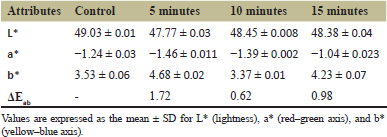 | Table 1. CIELAB colour analysis. [Click here to view] |
3.12. Multivariate Heat Map Analysis of Treatment-Induced Characteristics
Multivariate analysis was performed to evaluate the overall relationship between CO2 exposure duration and the biochemical responses of amla fruit. The heat map of Z-score standardized variables (Fig. 3a) showed that the 5 minutes treatment exhibited relatively higher values for TPC, scavenging activity, APX activity, and H2O2 levels compared with the other treatments. The pattern is consistent with the enhanced antioxidant response observed in the individual biochemical analyses [23,37]. In contrast, the 15 minutes treatment was associated with increased ascorbic acid content [33,35].
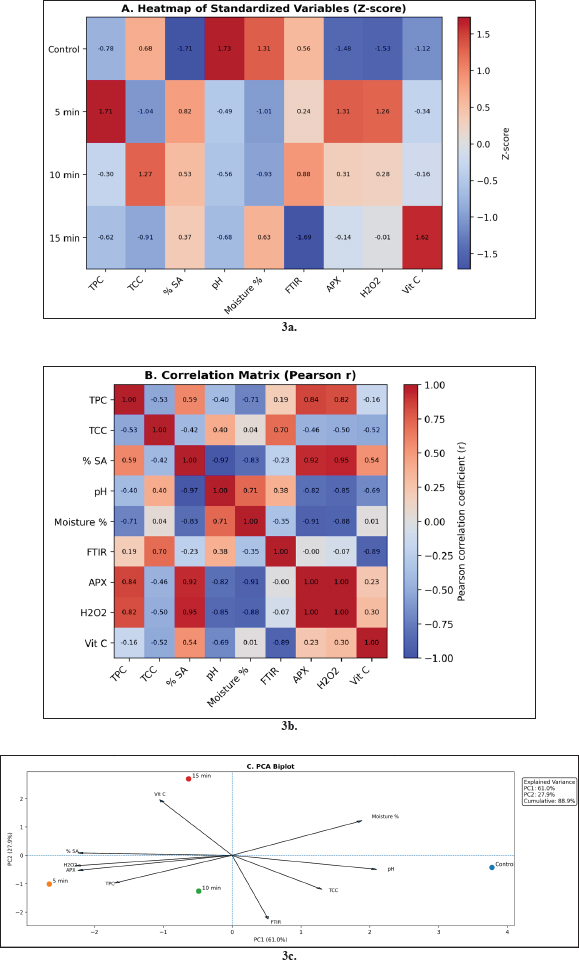 | Figure 3. Multivariate analysis of physicochemical and antioxidant parameters of CO2-treated amla fruit. a, Heat map of Z-score-standardized physicochemical and antioxidant variables. Darker shades indicate relatively higher values, whereas lighter shades indicate lower values relative to the mean. b, Pearson correlation matrix of physicochemical and antioxidant parameters. Positive correlations are represented by darker shades, and negative correlations by lighter shades. c, The PC1 and PC2 of the PCA biplot explained 61.0% and 27.9% of the total variance, respectively, with a cumulative explained variance of 88.9%. [Click here to view] |
The Pearson correlation matrix (Fig. 3b) is suggestive of a positive association among scavenging activity, APX activity, and H2O2 levels. These relationships propose the role of APX in the detoxification of H2O2 using ascorbate as an electron donor [42,46]. TPC also showed positive correlation with antioxidant-related parameters, suggestive of the contribution of phenolic compounds to the overall antioxidant capacity of the fruit [36]. In contrast, vitamin C showed a negative correlation with pH and Fourier Transform Infrared Spectroscopy (FT-IR) transmittance, indicating an inverse association among these variables under the experimental conditions evaluated.
The PCA biplot (Fig. 3c) provided an exploratory visualization of the relationships among the treatment means and the measured variables, with the first two principal components accounting for 88.9% of the total variance. The 5 minutes treatment was positioned in proximity to antioxidant-related variables, including APX, H2O2, TPC, and scavenging activity, whereas the 15 minutes treatment was positioned closer to vitamin C. The control treatment was associated with pH and moisture content. These observations are consistent with the trends obtained from the individual biochemical analyses under the present experimental conditions. Similar transient oxidative adjustments have been reported in horticultural commodities treated with modified atmospheric conditions, where moderate reactive oxygen species accumulation functions as a signalling mechanism that stimulates antioxidant metabolism and stress acclimation [46,48].
4. CONCLUSION
Short-term CO2 exposure enhanced antioxidant-related biochemical responses in amla fruit while producing only minor changes in the measured physicochemical and structural characteristics. A 5 minutes treatment produced the strongest overall antioxidant response, characterized by increased radical scavenging activity, increased APX activity, transient H2O2 accumulation, and higher phenolic content. In contrast, a 15 minutes exposure favoured greater ascorbic acid accumulation, accompanied by only minor changes in colour and molecular characteristics. The limited changes observed in moisture content, FT-IR spectral profiles, and colour parameters suggest that short-term CO2 exposure produced only minor alterations in the measured characteristics during the treatment period. Furthermore, studies focusing on molecular and transcriptomic responses could help clarify the regulatory mechanisms underlying these antioxidant responses.
5. AUTHOR CONTRIBUTIONS
All authors made substantial contributions to conception and design, acquisition of data, or analysis and interpretation of data; took part in drafting the article or revising it critically for important intellectual content; agreed to submit to the current journal; gave final approval of the version to be published; and agree to be accountable for all aspects of the work. All the authors are eligible to be authors as per the International Committee of Medical Journal Editors (ICMJE) requirements/guidelines.
6. FUNDING
This work was supported by a grant awarded to the first author by the University Grants Commission, India [Grant No. F 30-599/2021/BSR]. The authors gratefully acknowledge the analytical facilities provided by the School of Science and MURTI (Multi-disciplinary Unit of Research on Translation Initiatives), developed and maintained by GITAM Deemed to be University, Visakhapatnam.
7. ETHICAL APPROVALS
This study does not involve experiments on animals or human subjects.
8. DATA AVAILABILITY
All the data is available with the authors and shall be provided upon request.
9. PUBLISHER’S NOTE
All claims expressed in this article are solely those of the authors and do not necessarily represent those of the publisher, the editors and the reviewers. This journal remains neutral with regard to jurisdictional claims in published institutional affiliation.
10. CONFLICTS OF INTEREST
The authors report no financial or any other conflicts of interest in this work.
11. DECLARATION OF GENERATIVE AI
During the preparation of this manuscript, the authors used ChatGPT (GPT-4; OpenAI, San Francisco, CA, USA; https://chatgpt.com/) solely to assist with paraphrasing author-drafted text and improving English grammar, sentence structure, clarity, and readability. The tool was not used to generate scientific data, conduct literature searches or study selection, perform statistical analyses, interpret results, formulate scientific conclusions, generate or modify figures or images, or create references. All AI-assisted text was subsequently reviewed, verified, and revised by the authors to ensure scientific accuracy and appropriateness. The authors take full responsibility for the content, integrity, and final version of the manuscript.
REFERENCES
1. Dong J, Gruda N, Lam SK, Li X, Duan Z. Effects of elevated CO2 on nutritional quality of vegetables: a review. Front Plant Sci 2018;9:924.
2. Zhang Z, Liu L, Zhang M, Zhang Y, Wang Q. Effect of carbon dioxide enrichment on health-promoting compounds and organoleptic properties of tomato fruits grown in greenhouse. Food Chem 2014;153:157–63.
3. Wang SY, Bunce JA, Maas JL. Elevated carbon dioxide increases contents of antioxidant compounds in field-grown strawberries. J Agric Food Chem 2003;51:4315–20.
4. Packirisamy RM, Bobby Z, Panneerselvam S, Koshy SM, Jacob SE. Metabolomic analysis and antioxidant effect of amla (Emblica officinalis) extract in preventing oxidative stress-induced red cell damage and plasma protein alterations. J Med Food 2018;21(1):81–9; CrossRef
5. Braich AK, Kaur G, Singh A, Dar BN. Amla essential oil-based nano-coatings of amla fruit: analysis of morphological, physiochemical, enzymatic parameters and shelf-life extension. J Food Process Preservation 2022;46:e16498; CrossRef
6. Alkandari D, Sarfraz H, Sidhu JS. Development of a functional food (pan bread) using amla fruit powder. J Food Sci Technol 2019;56:2287–95.
7. Charoenphun N, Ban Z, Liu L, Paulraj B, Venkatachalam K. A review of post-harvest management practices and quality optimization strategies for Indian gooseberry (Phyllanthus emblica L.). Trends Sci 2025;22(12):11546; CrossRef
8. Anuradha, Kumar M, Jangra P, Saini P. Impact of pre-harvest calcium compounds on aonla (Emblica officinalis) shelf life. Int J Farm Sci 2025;15(2):55–9; CrossRef
9. Singh V, Pathak S, Deen B, Singh J, Pandey K. Effect of post-harvest treatments on shelf-life and fruit quality attributes of different cultivars of Indian gooseberry. J Innov Solutions For Eco-Environmental Sustainability 2025;1:6; CrossRef
10. Surendar KK, Balasubramanian P, Akila R, Chelviramesh Kumar SK. Post harvest physiological studies in aonla. Int J Res Agronomy 2024;7:1–4; CrossRef
11. Arora R, Jawandha SK, Gill KS, Thakur A. Physico-chemical attributes and shelf life of aonla as influenced by packing materials and storage conditions. Indian J Horticulture 2019;76(1):168–75; CrossRef
12. Singh V, Pathak S, Pandey K, Singh J. Effect of low-density polyethylene on shelf life and fruit quality of Indian gooseberry (Emblica officinalis Gaertn.). Int J Plant Soil Sci 2023;35(18):704–15; CrossRef
13. Tewari R, Kumar V, Sharma HK. Thermal and nonthermal processing of an underutilized fruit Emblica officinalis (Amla): a sustainable approach. Sustain Food Technol 2023;1(5):658–80; CrossRef
14. Falagán N, Terry LA. Recent advances in controlled and modified atmosphere of fresh produce. Johnson Matthey Technol Rev 2018;62(1):107–17; CrossRef
15. Qiao J, Guo L, Huo J, Huang D, Zhang Y. Controlled atmosphere effects on postharvest quality and antioxidant capacity of blue honeysuckle (Lonicera caerulea L.). Food Innov Adv 2024;3(2):155–66; CrossRef
16. Foyer C, Wang A, Shi K. CO2 signalling in plants. Phil Trans Roy Soc B Biol Sci 2025;380(1927):20240247; CrossRef
17. Lagarda-Clark EA, Goulet C, Duarte-Sierra A. Biochemical dynamics during postharvest: highlighting the interplay of stress during storage and maturation of fresh produce. BioMolecular Concepts 2024;15(1):20220048; CrossRef
18. Romero I, Toledo-Guerrero JD, Álvarez MD, Herranz B, Escribano MI, Merodio C, et al. Short-term gaseous treatments preserve firmness and fruit quality in raspberries stored at low temperature: impact on the expression of cell wall remodeling genes. Postharvest Biol Technol 2025;230:113777; CrossRef
19. Park MH, Ku KM, Do KR, Eum HL, Cho JH, Park PH, et al. Carbon dioxide treatment modulates phosphatidic acid signaling and stress response to improve chilling tolerance and postharvest quality in paprika. Front Plant Sci 2023;14:1287997; CrossRef
20. Del Olmo I, Romero I, Alvarez MD, Tarradas R, Sanchez-Ballesta MT, Escribano MI, et al. Transcriptomic analysis of CO2-treated strawberries (Fragaria vesca) with enhanced resistance to softening and oxidative stress at consumption. Front Plant Sci 2022;13:983976; CrossRef
21. Alamar MC, Collings E, Cools K, Terry LA. Impact of controlled atmosphere scheduling on strawberry and imported avocado fruit. Postharvest Biol Technol 2017;134:76–86; CrossRef
22. Thewes FR, Wood RM, Both V, Keshri N, Geyer M, Pansera-Espíndola B, et al. Dynamic controlled atmosphere: a review of methods for monitoring fruit responses to low oxygen. Comunicata Scientiae 2021;12; CrossRef
23. Bang J, Lim S, Yi G, Lee JG, Lee EJ. Integrated transcriptomic-metabolomic analysis reveals cellular responses of harvested strawberry fruit subjected to short-term exposure to high levels of carbon dioxide. Postharvest Biol Technol. 2019;148:120–131; CrossRef
24. Park MH, Kim SJ, Lee JS, Hong YP, Chae SH, Ku KM. Carbon dioxide pretreatment and cold storage synergistically delay tomato ripening through transcriptional change in ethylene-related genes and respiration-related metabolism. Foods 2021;10(4):744; CrossRef
25. Sadasivam S, Manickam A. Biochemical methods. 3rd ed, New Age International Publishers, New Delhi, India, 2008.
26. Teh Rou Xin J, Perveen N, Khan NH. Assessment of total phenolic content and antioxidant potential of Phyllanthus emblica using different solvents. Biomed J Sci Tech Res. 2022;46(4):37652–37666; CrossRef
27. Tamboli FA, More HN, Bhandugare SS, Patil AS, Jadhav NR, Killedar SG. Estimation of total carbohydrate content by phenol sulphuric acid method from Eichhornia crassipes (Mart.) Solms. Asian J Res Chem 2020;13:357–9.
28. Jack CN, Rowe SL, Porter SS, Friesen ML. A high-throughput method of analyzing multiple plant defensive compounds in minimized sample mass. Applications Plant Sci 2019;7(1):e01210; CrossRef
29. Kumar P. Measurement of ascorbate peroxidase activity in Sorghum. Bio-protocol 2022;12(20):e4531; CrossRef
30. Food Safety and Standards Authority of India. Manual of methods of analysis of foods: fruit and vegetable products. Ministry of Health and Family Welfare, Government of India, 2016. Available via https://fssai.gov.in/upload/uploadfiles/files/Manual_Fruits_Veg_25_05_2016(1).pdf
31. Ho QT, Verboven P, Mebatsion HK, Verlinden BE, Vandewalle S, Nicolaï BM. Microscale mechanisms of gas exchange in fruit tissue. New Phytologist 2009;182(1):163–74; CrossRef
32. Romero I, Vazquez-Hernandez M, Maestro-Gaitan I, Escribano MI, Merodio C, Sanchez-Ballesta MT. Table grapes during postharvest storage: a review of the mechanisms implicated in the beneficial effects of treatments applied for quality retention. Int J Mol Sci 2020;21(23):9320; CrossRef
33. Zheng X, Gong M, Zhang Q, Tan H, Li L, Tang Y, et al. Metabolism and regulation of ascorbic acid in fruits. Plants 2022;11(12):1602; CrossRef
34. Sharma R, Singh H. Alteration in biochemical constituents and nutrients partitioning of Asparagus racemosus in response to elevated atmospheric CO2 concentration. Environ Sci Pollut Res Int 2022;29(5):6812–21; CrossRef
35. Wu XJ, Sun S, Xing GM, Wang GL, Wang F, Xu ZS, et al. Elevated carbon dioxide altered morphological and anatomical characteristics, ascorbic acid accumulation, and related gene expression during taproot development in carrots. Front Plant Sci 2017;7: CrossRef
36. Sanchez-Ballesta MT, Romero I, Jiménez JB, Orea JM, González-Ureña A, Escribano MI, et al. Involvement of the phenylpropanoid pathway in the response of table grapes to low temperature and high CO2 levels. Postharvest Biol Technol 2007;46(1):29–35; CrossRef
37. Wu X, Zhong Y, Zhang L, Wei W, Wei S, Wei L, et al. Recent trends in small molecule gases for maintaining the postharvest quality of horticultural products: a review. Physiologia Plantarum 2025;177(4):e70361; CrossRef
38. Domínguez I, Lafuente MT, Hernández-Muñoz P, Gavara R. Influence of modified atmosphere and ethylene levels on quality attributes of fresh tomatoes (Lycopersicon esculentum Mill.). Food Chem 2016;209:211–9; CrossRef
39. Maldonado R, Molina-Garcia AD, Sanchez-Ballesta MT, Escribano MI, Merodio C. High CO2 atmosphere modulating the phenolic response associated with cell adhesion and hardening of Annona cherimola fruit stored at chilling temperature. J Agricult Food Chem 2002;50(26):7564–9; CrossRef
40. Romero I, Escribano MI, Merodio C, Sanchez-Ballesta MT. Postharvest high-CO2 treatments on the quality of soft fruit berries: an integrated transcriptomic, proteomic, and metabolomic approach. J Agricult Food Chem 2022;70(28):8593–7; CrossRef
41. Allende A, Marín A, Buendía B, Tomás-Barberán F, Gil MI. Impact of combined postharvest treatments (UV-C light, gaseous O3, superatmospheric O2 and high CO2) on health promoting compounds and shelf-life of strawberries. Postharvest Biol Technol 2007;46(3):201–11; CrossRef
42. Corpas FJ, González-Gordo S, Palma JM. Ascorbate peroxidase in fruits and modulation of its activity by reactive species. Journal of Experimental Botany 2024;75(9):2716–32; CrossRef
43. Cao S, Shao J, Shi L, Xu L, Shen Z, Chen W, et al. Melatonin increases chilling tolerance in postharvest peach fruit by alleviating oxidative damage. Sci Rep 2018;8(1):806; CrossRef
44. Aghdam MS, Palma JM, Corpas FJ. NADPH as a quality footprinting in horticultural crops marketability. Trends Food Sci & Technol 2020;103:152–61; CrossRef
45. Xu Z, Jiang Y, Zhou G. Response and adaptation of photosynthesis, respiration, and antioxidant systems to elevated CO2 with environmental stress in plants. Front Plant Sci 2015;6:701; CrossRef
46. Cassia R, Nocioni M, Correa-Aragunde N, Lamattina L. Climate change and the impact of greenhouse gasses: CO2 and NO, friends and foes of plant oxidative stress. Front Plant Sci 2018;9: 273; CrossRef
47. Nakano Y, Asada K. Hydrogen peroxide is scavenged by ascorbate-specific peroxidase in spinach chloroplasts. Plant Cell Physiol 1981;22(5):867–80; CrossRef
48. Foyer CH, Noctor G. Redox homeostasis and signaling in a higher-CO2 world. Annu Rev Plant Biol 2020;71:157–82; CrossRef
49. Avinash PG, Hamid, Shams R, Dash KK, Shaikh AM, Ungai D, et al. Recent insights into the morphological, nutritional and phytochemical properties of Indian gooseberry (Phyllanthus emblica) for the development of functional foods. Plants. 2024;13(5):574; CrossRef
50. Raju CA, Begum SS, Kalpana B, Sathish A. Processing and Nutritional Evaluation of Amla (Phyllanthus emblica) Pomace. Asian J Dairy Food Res 2025;44(6):968–73.
51. Kahina Z, Kati D, Benchikh Y, Ouandjeli D, Yahiaoui S, Bey M. The use of modified atmosphere packaging as mean of bioactive compounds and antioxidant activities preservation of fresh figs (Ficus carica L.) from rare cultivars. Ann Univ Dunarea Jos Galati 2020;44:149–164; CrossRef
52. Gil MI, Holcroft DM, Kader AA. Changes in strawberry anthocyanins and other polyphenols in response to carbon dioxide treatments. J Agricult Food Chem 1997;45(5):1662–7; CrossRef
53. Blanch M, Sanchez-Ballesta MT, Escribano MI, Merodio C. The relationship between bound water and carbohydrate reserves in association with cellular integrity in Fragaria vesca stored under different conditions. Food Bioprocess Technol 2014;8(4):875–84; CrossRef
54. Vazquez-Hernandez M, Romero I, Escribano MI, Merodio C, Sanchez-Ballesta MT. Deciphering the role of cbf/dreb transcription factors and dehydrins in maintaining the quality of table grapes cv. Autumn royal treated with high CO2 levels and stored at 0 °C. Front Plant Sci 2017;8:1591; CrossRef
55. Ziuzina D, Misra NN, Han L, Cullen PJ, Moiseev T, Mosnier JP, et al. Investigation of a large gap cold plasma reactor for continuous in-package decontamination of fresh strawberries and spinach. Innov Food Sci & Emerg Technol 2020;59:102229; CrossRef
56. Andronie L, Holonec L, Pop I, Truta AM, Odagiu A, S?l?gean T, et al. Antioxidant capacity of several Romanian forest fruits (Rosa canina L., Prunus spinosa L., Vaccium vitis-idaea L. and Cornus mas L.). Notulae Botanicae Horti Agrobotanici Cluj-Napoca 2019;47(4):1178–84; CrossRef
57. Sánchez Orozco R, Balderas Hernández P, Roa Morales G, Ureña Núñez F, Orozco Villafuerte J, Lugo Lugo V, et al. Characterization of lignocellulosic fruit waste as an alternative feedstock for bioethanol production. BioResources 2014;9(2):1873–85; CrossRef
58. Di Egidio V, Sinelli N, Limbo S, Torri L, Franzetti L, Casiraghi E. Evaluation of shelf-life of fresh-cut pineapple using FT-NIR and FT-IR spectroscopy. Postharvest Biol Technol 2009;54(2):87–92; CrossRef
59. Fernández-Vázquez R, Stinco CM, Hernanz D, Heredia FJ, Vicario IM. Colour training and colour differences thresholds in orange juice. Food Qual Preference 2013;30(2):320–7; CrossRef
60. Remón S, Ferrer A, López-Buesa P, Oria R. Atmosphere composition effects on Burlat cherry colour during cold storage. J Sci Food Agriculture 2004;84(2):140–6; CrossRef
61. Chandra D, Lee J, Hong YP, Park M, Choi AJ, Kim JG. Short-term application of CO2 gas: effects on physicochemical, microbial, and sensory qualities of “Charlotte” strawberry during storage. J Food Saf 2019;39:e12597; CrossRef