1. INTRODUCTION
Sesame (Sesamum indicum L.) is an ancient oilseed crop, generally known as “queen of oilseeds” owing to its nutritional and medicinal value. It is a highly valued crop due to its oil content, which ranges from 41.3% to 62.7% [1], besides serving as a rich source of antioxidants and unsaturated fatty acids [2]. The sesame seeds, which are often used in culinary, confectionery, and medicinal purposes, are a rich source of oil that is highly resistant to oxidative deterioration [3]. Despite its economic importance, sesame is primarily grown as a marginal crop in arid and semi-arid regions worldwide [4]. Moreover, sesame, being a short-day plant, requires shorter day-length to promote flowering. Since flowering is a vital phenomenon that culminates in the seed-setting process, there is a possibility of enhancing the productivity potential of the sesame crop by regulating the flowering timing of those plants [5].
Flowering in angiosperms involves several synchronized events that are regulated by both genetic and environmental factors. While the genetic factors that regulate flower development comprise the homeotic genes, the environmental factors that influence flowering in plants include plant age, photoperiod, temperature vagaries, carbon-to-nitrogen ratio, and hormonal balance [6]. The interplay of these floral homeotic genes results in the establishment of distinct organ identities as well as their differentiation into distinct whorls, namely: sepals, petals, stamens, and carpels [7]. Although previous studies have reported the homeotic genes with a role in flowering in the model plant species, namely, Arabidopsis thaliana [8], Antirrhinum majus [9], and Petunia hybrida [10], the homeotic genes involved in flowering in sesame are yet to be identified. With this rationale, it is hypothesized that a similar set of homeotic genes might be involved in regulating floral induction and organ identity in sesame, and these homeotic genes might be conserved across the different plant members, including S. indicum.
Previous reports on the draft genome sequencing of the high oil-yielding (59%) Chinese sesame genotype, Zhongzhi No. 13, revealed an estimated number of 27,148 genes with the possibility of further genetic studies in sesame [11]. However, the functions of most of the sesame genes remain largely unknown, with only a few gene families been detected in sesame such as the MADS family of genes with a role in plant growth and development [12]. In the genome of S. indicum, 57 MADS-box genes were identified that showed predominant phylogenetic association with A. thaliana, Utricularia gibba, and Solanum lycopersicum, and were located to 14 linkage groups of Sesamum chromosomes. Although the MADS-box genes were identified in seven different tissues of sesame with a predicted role in growth and development, the relative expression of the homeotic genes at different stages of the flower and in different parts of the sesame flower needs to be explored. A recent study involving a genome-wide search for candidate MADS-box genes in wild and cultivated red gram (Cajanus cajan L.) revealed 71 of those genes to be evolutionarily conserved in three wild Cajanus species, namely, C. cajanifolius, C. platycarpus, and C. scarabaeoides [13]. Therefore, based on the above rationale, an attempt is made to understand the molecular mechanism that regulates floral induction and organ identity in sesame through genome-wide identification of homeotic genes using an in silico approach and gene expression studies, and the findings are presented.
2. MATERIALS AND METHODS
2.1. A Genome-wide Search for Putative Floral Homeotic Genes
The genome database of sesame (S. indicum L.) (tax id: 4128) available in the National Center for Biotechnology Information (NCBI) was utilized for putative floral homeotic genes. The reported sequences belonging to the MADS-box family in the model plants—A. thaliana, A. majus, and P. hybrida were searched by BLASTn in the sesame database program (https://www.ncbi.nlm.nih.gov/datasets/genome/GCF_000512975.1/). The homologous gene sequences were aligned using Clustal Omega (European Bioinformatics Institute, Cambridge, UK). Gene sequences with nucleotide homology ≥ 80% were selected. The biological function of these sequences was predicted using InterPro and BLASTP tools. The subcellular localization of these homologous sequences was predicted using the LOCALIZER tool (https://localizer.csiro.au/). The putative promoters were detected using the Promoter-2.0 tool (https://services.healthtech.dtu.dk/services/Promoter-2.0/).
2.2. Genetic Similarity Analysis and Mapping of Putative ABCDE Genes
The homologous sesame gene sequences with a homology of ≥75% were identified through BLAST hits along with their accession identity (ID). Likewise, to detect interspecific conservancy of these putative homeotic genes, the level of homology of the sesame sequences with other related plant members, such as A. thaliana, A. majus, and P. hybrida, was determined using the BLAST search tool. The location of the putative homeotic genes on the chromosomes or linkage group, the cDNA sequences were used as query sequences for the BLASTN search against the S. indicum whole genome (Sinbase). The putative open reading frames (ORFs) were detected using the NCBI ORF finder tool. The BLASTP of NCBI was used to determine the functional domains of the putative floral homeotic genes.
2.3. Phylogenetic Analysis and Protein-interaction Network of Putative Homeotic Genes
The sesame floral homeotic gene sequences were aligned using ClustalW with Arabidopsis, Antirrhinum, and Petunia gene sequences. A phylogenetic tree was constructed using the maximum likelihood method in the MEGA12 software using a 1000-replicate bootstrap sampling test. The evolutionary relationship was assessed based on the number of synonymous and non-synonymous substitutions per site, as adopted previously [14]. The gene clusters in the phylogenetic tree correspond to the distinct classes in the ABCDE model of flowering. The STRING database search tool was used for the retrieval of interacting putative homeotic genes (https://string-db.org). This computation tool allows the detection of functional interactions of proteins by integrating both known and predicted protein–protein interactions.
2.4. Plant Material, Growth Conditions, and Sampling
The seeds of the sesame genotype, Rajeshwari, used in the study were obtained from the Indian Institute of Oilseeds Research (IIOR) at Rajendranagar, Hyderabad, Telangana, India. The plants were grown in the plant culture facility, University of Hyderabad, under optimal plant growth conditions comprising a temperature range of 21–25°C/16–19°C (day/night, respectively). The floral buds were harvested at five distinct stages as described previously [15,16] and listed in Supplementary Table S1. Samples comprising different parts of the flower, namely: Sepals, petals, androecium, and gynoecium, were harvested at the fourth-bud stage. The same-aged floral buds, 3–4 in number per floral stage, were harvested separately. The samples were frozen in liquid nitrogen and stored at −80°C.
2.5. Nucleic Acid Isolation, cDNA Synthesis, and Primer Design
DNA was extracted from the floral and leaf samples by the CTAB method as described previously [17]. RNA was extracted using TRIzol reagent (Takara) as directed by the manufacturer. The cDNA synthesis was performed using 2 μg/μL of total RNA pooled from three biological replicates per treatment using the Prime Script reverse transcriptase-polymerase chain reaction (RT-PCR) Kit (Takara) following the manufacturer’s protocol. Primers were designed from conserved domain sequences of putative homeotic genes. The primers used for RT-PCR [Supplementary Table S2] and real-time quantitative (RT-q) PCR [Supplementary Table S3], along with annealing temperatures, are listed.
2.6. Genomic and RT-PCR for the Putative Homeotic Genes
Genomic polymerase chain reaction (PCR) and RT-PCRs were performed using gene-specific primers for all 32 putative homeotic genes. The optimized genomic PCR conditions were: denaturation at 95°C for 4 min, followed by 35 cycles each with a denaturation step at 94°C for 40 s, and annealing temp between 49–70°C specific to the primers at 45 s and an extension step at 72°C for 1 min followed by a final elongation step at 72°C for 10 min which was performed on an Arktik Thermal Cycler machine (Thermofisher Scientific). The cDNA amplification was performed by RT-PCRs for different floral stages and leaf samples following the conditions: Denaturation at 94°C for 4 min, followed by 35 cycles each with a denaturation step at 94°C for 40 s, and annealing temp between 49–60°C specific to the primers at 45 s and an extension step at 72°C for 70 s followed by a final elongation step at 72°C for 7 min which was performed on an Arktik Thermal Cycler machine. PCR amplification efficiency and optimization conditions were standardized for all the genes. The amplified cDNA products were sequenced employing the sequencing services at Eurofins Genomics India Pvt. Ltd.
2.7. Confirming ABCDE Genes by Cloning, Sequencing, and Multiple Sequence Alignment
The amplified cDNA products of 5 putative gene sequences for each of the ABCDE classes were cloned into the pGMET Easy vector and sequenced. Using the ORF finder program (http://www.ncbi.nlm.nih.gov/gorf/gorf.html), the ORFs were detected. The in silico tool, BLASTP, was used to search conserved protein domains. Multiple sequence alignment was performed to identify highly conserved sequences using Clustal Omega 1.2.4.
2.8. Validating ABCDE Gene Candidates by RT-qPCR
A sample of cDNA (1 μg) was added to a final volume of 10 μl containing 5.2 μl SYBR Green Master Mix Reagent (Takara) and specific primers (3 pmol) were set for RT-qPCR with the following PCR program: 95°C for 2 min followed by 40 cycles of 95°C for 15 s, specific annealing temperature for a specific gene for 30 s and 72°C for 20 s. The RT-qPCR was analyzed in triplicate in a 96-well PCR plate (Applied Biosystems) on the real-time Eppendorf Master cycler with gene-specific primers for DAPs [Supplementary Table S3]. The Actin, DNA-J, and Ubiquitin6 (UBQ6) [16] gene primers were used as internal controls for the normalization of gene expression. The relative fold change in gene expression was calculated by 2−ΔΔCt for all the genes in the treatments [18]. Statistical analysis was performed by plotting RT-qPCR data using SigmaPlot 11.0 and ANOVA to test the significance of variation using GraphPad Prism version 7.04 (La Jolla, CA, USA).
3. RESULTS AND DISCUSSION
In higher eudicotyledonous plants, the identity of the floral organs has been reported to be specified by different classes of homeotic genes, and the majority of these homeotic genes belong to the MADS-box family, which encodes the transcription factors [19,20]. The floral quartet model proposed by Smaczniak et al. [21] suggested that the A- and E-class protein complexes determine the development of sepals in the first floral whorl. In the second whorl, the A-, B-, and E-class protein complexes specify petals. In the third whorl, the B-, C-, and E-class protein complexes determine the formation of stamens. Finally, in the fourth whorl, the C- and E-class protein complexes specify carpels. Although MADS-box genes were initially found to be major players in floral organ specification, subsequent studies revealed their involvement in the morphogenesis of plant organs throughout the plant’s life cycle. The MADS-box gene family is one of the largest families found in higher plants, with a large number of duplication events that allowed functional divergence of the individual paralogs [21].
In a previous study involving a genome-wide detection and analysis of MADS-box genes, a total of 57 genes were identified from 14 linkage groups (LGs) in the sesame genome, including 33 type II and 24 type I MADS-box genes [12]. The sesame MADS-box genes were analyzed in seven different types of tissues, indicating their ABCDE functions. Furthermore, to gain a deeper understanding of the process of transition from the vegetative to the reproductive phase in sesame, it is necessary to identify and analyze the putative homeotic genes involved in floral induction and floral organ identity. The present study involves the detection of putative homeotic genes and their expression at different stages of the flower and in different parts of the sesame flower in comparison to leaf tissue.
3.1. Homology-based Identification, Isolation, and Sequencing of Putative Homeotic Genes
A total of 32 putative floral homeotic or floral organ identity gene sequences were detected in the genome of S. indicum, which showed high sequence homology with the reported homeotic genes belonging to the MADS-box family and other floral development protein domains in the model plants, such as A. thaliana, A. majus, and P. hybrida, as shown in Table 1. The gene ontology studies revealed that out of the 32 putative homeotic genes, 23 genes exhibited MADS domains, whereas nine were predicted to be the putative transcription factors (TFs). Of these nine TFs, three genes each were related to the FLORICAULA/LEAFY (FLO/LFY) and F-box superfamily, respectively, two genes exhibited the homeodomain superfamily, and one gene exhibited the APETALA2 (AP2) superfamily. The three putative homeotic genes –SiLEAFY (SiLFY)–, SiFLORICAULA (SiFLO)-, and SiABERRANT LEAF AND FLOWER (SiALF)-like genes detected in sesame exhibited FLO/LFY MADS-box domain with DNA binding motifs that were plant-specific. These sequences showed a significant level of similarity to the TFs of LFY of A. thaliana, FLO of A. majus, and ABERRANT LEAF AND FLOWER (ALF) of P. hybrida, respectively [Table 1], indicating their evolutionary conservation in angiosperms. The TF FLO/LFY was first identified in A. majus [22], and subsequently in several other plant species with an established role in flowering, especially during the transition from vegetative to reproductive phase [23].
Table 1: Putative floral homeotic genes detected in sesame.
| Class | Putative homeotic genes inSesamum indicum | Gene homologs identified in other plant spp. | Conserved domain/Function | ||
|---|---|---|---|---|---|
| Arabidopsis | Antirrhinum | Petunia | |||
| *TF | SiLEAFY (SiLFY), SiFLORICAULA (SiFLO) SiABERRANT LEAF AND FLOWER (SiALF) | LEAFY | FLORICAULA | ALF | DNA binding; plant-specific (FLO-LFY SP)/MADS BOX Domain |
| *TF | SiWUSCHEL (SiWUS) SiTERMINATA (SiTER) | WUS | TER | Homeodomain/MADS BOX Domain | |
| *TF | SiUNUSUAL FLORAL ORGANS (SiUFO) SiFIMBRIATA (SiFIM) SiDOUBLE TOP (SiDOT) | UFO | FIMBRIATA | DOT | F-box Superfamily |
| *TF | SUPPRESSOR OF OVEREXPRESSION OF CONSTANS1 (SiSOC1) | SOC1 | MADS Domain | ||
| A | SiAPETALA1 (SiAP1) SiSQUAMOSA (SiSQUA) SiPETUNIA FLOWERING GENE (SiPFG) | APETALA1 | SQUAMOSA | PFG | MADS Domain |
| A | SiAPETALA2 (SiAP2) | AP2 Domain | |||
| B | SiAPETALA3 (SiAP3) SiDEFECIENS (SiDEF) SiTOMATO MADS-BOX GENE 6 (SiTM) | APETALA3 | DEFICIENS | TM6 | MADS Domain |
| B | SiPISTILLATA (SiPI) SiGLOBOSA (SiGLO) SiGLOBOSA1 (SiGLO1) SiMADS2 | PISTILATA | GLOBOSA | GLO1 MADS2 | MADS Domain |
| C | SiAGAMOUS (SiAGA) SiPLENA (SiPLE) SiMADS3 SiFLORAL BINDING PROTEIN 6 (SiFBP6) | AGAMOUS | PLENA | MADS3 FBP6 | MADS Domain |
| D | SiSEED STICK (SiSTK) SiFLORAL BINDING PROTEIN 7 (SiFBP) SiFLORAL BINDING PROTEIN 11 (SiFBP11) | STK | FBP7 FBP11 | MADS Domain | |
| E | SiSEPALLATA(SiSEP1) SiSEPALLATA (SiSEP2) SiSEPALLATA(SiSEP3) SiDEFH49 SiFLORAL BINDING PROTEIN 2 (SiFBP2) | SEP1 SEP2 SEP3 | DEFH49 | SiFBP2 | MADS Domain |
Likewise, two putative homeotic genes –WUSCHEL (SiWUS)– and SiTERMINATA (SiTER)-like genes detected in sesame exhibited homeodomain/MADS-box domain and showed similarity to the TFs–WUS of A. thaliana and TER of P. hybrida, indicating their putative regulatory function in sesame. The TF, WUS and its ortholog, PhWUSCHEL or TER in Petunia are central to the maintenance of the shoot apical meristem (SAM) for shoot and floral meristem identity [24]. Previous studies have demonstrated the role of the WUS gene in the structural and functional integrity of the floral organs in Arabidopsis [25]. Further, the TF, SUPPRESSOR OF OVEREXPRESSION OF CONSTANS1 (SiSOC)-like gene of sesame carrying the MADS domain, showed significant homology with the SOC1 gene of A. thaliana. The TF, SOC1, functions as a flowering pathway integrator by integrating multiple flowering signals from various external and intrinsic developmental factors [26]. The remaining three putative TFs detected in sesame, namely: SiFIMBRIATA (SiFIM)-, SiUNUSUAL FLORAL ORGANS (SiUFO)-, and SiDOUBLE TOP (SiDOT)-like genes belonging to the F-box superfamily, were found to be homologous to UNUSUAL FLORAL ORGANS (UFO), FIMBRIATA (FIM), and DOUBLE TOP (DOT) genes of A. thaliana, A. majus, and P. hybrida, respectively, indicating conservancy of these homeotic TFs across the plant species with a role in flowering. The TF, UFO, was the first plant F-box gene shown to function in floral meristem identity by activating APETALA3 and PISTILLATA, which are required to establish the whorled pattern of floral organs in Arabidopsis [27].
Similarly, the remaining 22 genes with MADS domains identified in sesame in this study were homologous to various classes of ABCDE genes in A. thaliana, A. majus, and P. hybrid, as shown in Table 1. The 22 genes with MADS domain detected in the study were grouped into various classes of ABCDE genes, as previously identified by Thiessen [28]. This indicates that the MADS-box gene structure, expression, and function play a crucial role in plant reproductive development, involving flower, fruit, and seed formation. These putative gene sequences were grouped into separate classes: Class A with four gene homologs (SiAPETALA1 [SiAP1], SiPETUNIA FLOWERING GENE [SiPFG], SiAPETALA2 [SiAP2] and SiSQUAMOSA [SiSQUA]), Class B with seven genes (SiAPETALA3 [SiAP3], SiDEFECIENS [SiDEF], SiTOMATO MADS-BOX GENE 6 [SiTM], SiPISTILLATA [SiPI], SiGLOBOSA [SiGLO], SiGLOBOSA1 [SiGLO1] and SiMADS2), Class C with four genes (SiAGAMOUS [SiAGA], SiPLENA [SiPLE], SiMADS,3 and SiFLORAL BINDING PROTEIN 6 [SiFBP6]), and Class D with three genes (SiSEED STICK [SiSTK], SiFLORAL BINDING PROTEIN 7 [SiFBP], and SiFLORAL BINDING PROTEIN 11 [SiFBP11]). The five genes homologous to Class E genes were SiSEPELLATA (SiSEP1), SiSEPELLATA (SiSEP2), SiSEPELLATA (SiSEP3), SiDEFH49, and SiFLORAL BINDING PROTEIN 2 (SiFBP2). Previous studies also revealed the detection of SQUAMOSA (SQUA) representing Class A, DEFICIENS (DEF)- or GLOBOSA (GLO) representing Class B, AGAMOUS (AG)- representing Class C and D, and SEPALLATA (SEP)-like genes representing Class E [28]. Our studies also revealed the conservancy of these genes in sesame with a role in floral organ identity.
The study also revealed the molecular characteristics of the putative homeotic genes detected in S. indicum, as shown in Table 2. The putative floral homeotic genes were categorized into ABCDE gene classes in sesame based on their conserved domains and amino acid sequences. Of the 32 gene sequences, 28 gene sequences were identified in the S. indicum genome that showed homology to the previously reported genes in other plant species. Whereas the three genes: SiSOC, SiTM6, and SiSTK, whose gene sequences have been detected in this study based on in silico and gene expression studies, have not been annotated so far. These genes showed evolutionary conservancy with the ABCDE genes detected previously in other plant members, indicating their role in floral induction and flower development as previously described [19]. Further, these gene sequences were analyzed for linkage mapping, cellular localization, and promoter detection as shown in Table 2.
Table 2: Characteristic features of 32 putative floral homeotic gene sequences identified in sesame.
| Gene Name | Gene | Gene sequence | mRNA sequence (bp) | Coding sequence (bp) | Protein sequence (aa) | Linkage group | Cellular-detected | Promoter detected | |
|---|---|---|---|---|---|---|---|---|---|
| Start | End | ||||||||
| SiLFY | 13,606,522 | 13,617,947 | 11426 | 1764 | 1223 | 407 | LG3 | Nucleus | P |
| SiFLO | 13,606,522 | 13,617,947 | 11426 | 1764 | 1223 | 407 | LG3 | Nucleus | P |
| SiALF | 13606522 | 13617947 | 11426 | 1764 | 1223 | 407 | LG3 | Nucleus | P |
| SiWUS | 9234035 | 9236969 | 2934 | 2029 | 1059 | 352 | LG1 | Nucleus | P |
| SiTER | 13,606,522 | 13,617,947 | 11426 | 1764 | 1223 | 407 | LG3 | Nucleus | P |
| SiUFO | 6202015 | 6205620 | 3606 | 3606 | 1322 | 440 | LG12 | Chloroplast | P |
| SiFIM | 6202015 | 6205620 | 3606 | 3606 | 1322 | 440 | LG12 | Chloroplast | P |
| SiDOT | 23434240 | 23436190 | 1951 | 798 | 705 | 234 | LG3 | Nucleus | P |
| SiSOC1 | N/A | N/A | N/A | N/A | N/A | N/A | N/A | N/A | N/A |
| SiAP1 | 16802802 | 16816066 | 13265 | 1917 | 1383 | 460 | LG2 | Nucleus | P |
| SiSQUA | 10709817 | 10713094 | 3278 | 2431 | 1392 | 463 | LG1 | Nucleus | P |
| SiPFG | 13738216 | 13747543 | 9328 | 1547 | 774 | 257 | LG8 | Mitochondria, | P |
| SiAP2 | 509396 | 512889 | 3494 | 1920 | 1416 | 471 | LG5 | Nucleus Nucleus | P |
| SiAP3 | 23434240 | 23436190 | 1951 | 798 | 705 | 234 | LG3 | Nucleus | P |
| SiDEF | 23434240 | 23436190 | 1951 | 798 | 705 | 234 | LG3 | Nucleus | P |
| SiTM6 | N/A | N/A | N/A | N/A | N/A | N/A | NA | N/A | N/A |
| SiPI | 17831557 | 17833792 | 1956 | 919 | 639 | 212 | LG6 | Nucleus | NP |
| SiGLO | 17831557 | 17833792 | 2,236 | 919 | 639 | 212 | LG6 | Nucleus | NP |
| SiGLO1 | 17831557 | 17833792 | 2,236 | 919 | 639 | 212 | LG6 | Nucleus | NP |
| SiMADS2 | 17833537 | 17833688 | 2,236 | 919 | 639 | 212 | LG6 | Nucleus | NP |
| SiAG | 2,855,020 | 2,865,915 | 10,896 | 1059 | 696 | 231 | LG14 | Nucleus | P |
| SiPLE | 23,106,254 | 23,114,208 | 7,955 | 1248 | 753 | 250 | LG6 | Nucleus | P |
| SiMADS3 | 12922 | 18268 | 5,347 | 1257 | 732 | 243 | LG8 | Nucleus | P |
| SiFBP6 | 23106254 | 23114208 | 7955 | 1248 | 753 | 250 | LG6 | Nucleus | P |
| SiSTK | NA | NA | NA | NA | NA | NA | NA | NA | N/A |
| SiFBP7 | 423532 | 428653 | 4801 | 1094 | 669 | 222 | LG2 | Nucleus | P |
| SiFBP11 | 423532 | 428653 | 4801 | 1094 | 669 | 222 | LG2 | Nucleus | P |
| SiSEP1 | 2339457 | 2344824 | 5368 | 1522 | 744 | 247 | LG15 | Nucleus | P |
| SiSEP2 | 2339457 | 2344824 | 5368 | 1522 | 744 | 247 | LG15 | Nucleus | P |
| SiSEP3 | 12847465 | 12856220 | 8756 | 1194 | 680 | 242 | LG8 | Nucleus | P |
| SiDEFH49 | 2,339,457 | 2,344,824 | 5,368 | 1522 | 744 | 247 | LG15 | Nucleus | P |
| SiFBP2 | 5,738 | 10,719 | 4,982 | 1201 | 714 | 237 | LG8 | Nucleus | NP |
The cDNA sequences of all 32 putative homeotic genes were analyzed to identify protein domains and nucleotide similarity with those of the reported homeotic genes from other model plant species. The cDNA sequences of all 32 putative homeotic genes were submitted to the NCBI, and the GenBank accession numbers are listed in Table 3. The nucleotide similarity and protein domain conservancy analyses revealed high sequence homology with other model plant species – A. thaliana, A. majus, and P. hybrida. The percentage nucleotide similarity ranged between 81% and 100%. The MADS-Box domains were found in the majority of the gene sequences, with the exception of the SiAP2 (SiAPETALA2)-like gene, which is a member of the AP2 superfamily. The APETALA2 gene differs from the other organ identity genes with regard to the absence of a MADS domain and a region-specific pattern [29].
Table 3: The partial cDNA sequences of the 32 putative homeotic genes in sesame obtained through RT-PCR-based gene expression, along with their accession numbers, domains, and nucleotide similarity with reported homeotic genes from other model plant species.
| Gene Name | Partial cDNA sequence (bp) | Domain | Query sequences (Accession No.) | Petunia (%) | Antirrhinum (%) | Arabidopsis (%) |
|---|---|---|---|---|---|---|
| SiLFY | 620 | FLO-LFY SP | OQ092330 | 92 | 89 | 95 |
| SiFLO | 997 | FLO-LFY SP | OQ092333 | 85 | 87 | 90 |
| SiALF | 635 | FLO-LFY SP | OQ092335 | 86 | 83 | 89 |
| SiWUS | 232 | Homeodomain | OQ092336 | 91 | 93 | 87 |
| SiTER | 625 | Homeodomain | OQ092332 | 86 | 97 | 97 |
| SiUFO | 313 | F-box | OQ092337 | 91 | 89 | 82 |
| SiFIM | 372 | F-box | OQ092334 | 89 | 96 | 94 |
| SiDOT | 995 | F-box | OQ092353 | 93 | 85 | 93 |
| SiSOC1 | 962 | MADS | OQ092331 | 80 | 86 | 96 |
| SiAP1 | 790 | MADS | KM677186 | 99 | 98 | 100 |
| SiSQUA | 606 | MADS | OQ092352 | 92 | 99 | 97 |
| SiPFG | 382 | MADS | OQ092338 | 86 | 92 | 93 |
| SiAP2 | 883 | AP2 | KM190074 | 91 | 94 | 98 |
| SiAP3 | 798 | Superfamily MADS | KM190075 | 93 | 95 | 100 |
| SiDEF | 986 | MADS | OQ033392 | 82 | 91 | 90 |
| SiTM6 | 846 | MADS | OQ092344 | 89 | 90 | 82 |
| SiPI | 680 | MADS | OQ092350 | 96 | 83 | 91 |
| SiGLO | 288 | MADS | OQ092349 | 93 | 89 | 85 |
| SiGLO1 | 590 | MADS | OQ092340 | 96 | 98 | 89 |
| SiMADS2 | 352 | MADS | OQ092348 | 82 | 96 | 92 |
| SiAG | 735 | MADS | KM190076 | 98 | 99 | 100 |
| SiPLE | 576 | MADS | OQ092347 | 92 | 95 | 90 |
| SiMADS3 | 718 | MADS | OQ092421 | 99 | 89 | 86 |
| SiFBP6 | 420 | MADS | OQ092343 | 97 | 94 | 83 |
| SiSTK | 579 | MADS | OQ198411 | 95 | 90 | 99 |
| SiFBP7 | 364 | MADS | OQ092342 | 83 | 86 | 81 |
| SiFBP11 | 372 | MADS | OQ092345 | 93 | 96 | 82 |
| SiSEP1 | 391 | MADS | OQ092352 | 98 | 96 | 97 |
| SiSEP2 | 691 | MADS | OQ092351 | 92 | 93 | 96 |
| SiSEP3 | 629 | MADS | KF601336 | 100 | 99 | 100 |
| SiDEFH49 | 596 | MADS | OQ092346 | 97 | 89 | 88 |
| SiFBP2 | 501 | MADS | OQ092339 | 94 | 96 | 90 |
RT-PCR: Reverse transcriptase-polymerase chain reaction
3.2. Genetic-relatedness of Sesame Homeotic Genes with Orthologs from Other Plant spp.
To analyze the evolutionary relatedness of the detected homeotic genes of sesame with the reported floral organ genes identified from the model plants – A. thaliana, A. majus, and P. hybrida, a phylogenetic tree was constructed with the cDNA sequences of 67 homeotic genes, including the 32 potential genes from sesame detected in this study [Figure 1]. The study revealed homology-based grouping of all sesame homeotic gene sequences with their orthologous gene sequences from A. thaliana, A. majus, and P. hybrida. The sesame homeotic gene sequences were functionally categorized into five classes of the ABCDE model of flower development. These clusters comprised four gene homologs grouped as Class A, seven as Class B, four as Class C, three as Class D, five as Class E, and nine as the putative TFs, as discussed in section 3.1 of results and discussion, indicating their potential role in floral gene regulation. Previous studies also revealed that most organ identity genes are regulated at the mRNA level, possibly through direct transcriptional control. The floral homeotic control genes appear to encode transcription factors [28].
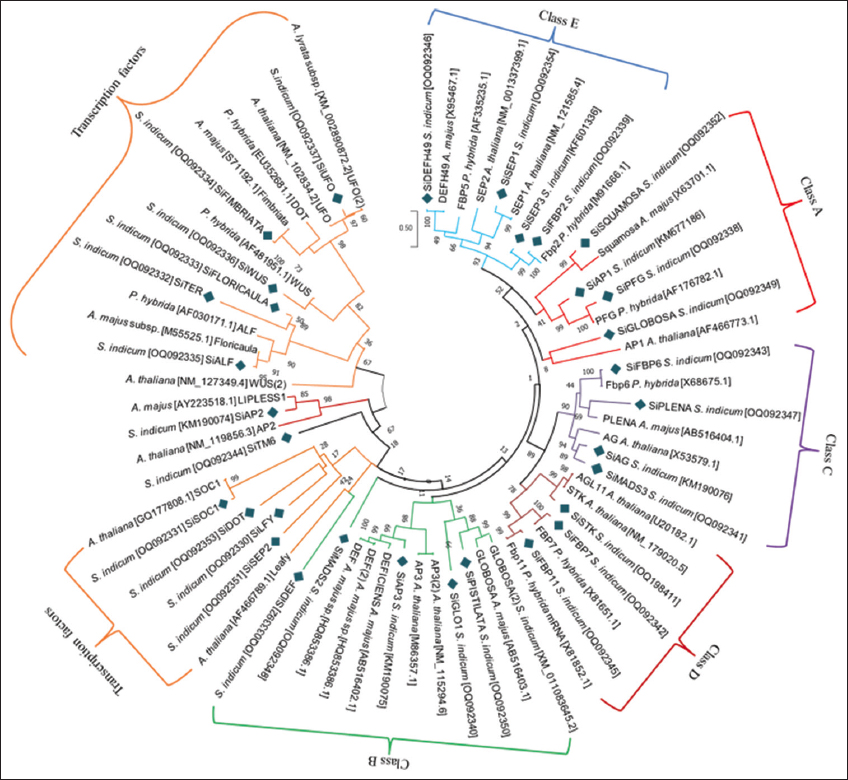 | Figure 1: Phylogenetic tree drawn using putative sesame homeotic gene sequences in comparison to reported floral homeotic genes of other model plant species. A phylogenetic tree was constructed using the maximum likelihood method in the MEGA12 software using a 1000-replicate bootstrap sampling test. The 67 partial cDNA sequences of Sesamum indicum, Arabidopsis thaliana, Petunia hybrida, and Antirrhinum majus are indicated by green, pink, light blue, and dark blue colors, respectively. [Click here to view] |
3.3. Identification of Protein Interaction Networks
Using the STRING tool, potential interactions between the reported floral proteins were detected with nodes corresponding to the proteins and the edges (lines) indicating the interactions. A total of 16 proteins out of 32 exhibited a significant level of interaction with each other, forming a network with a specific number of nodes. There are 16 edges in total. The P-value with <1.0e-16 for the enrichment of 81 protein–protein interactions suggested a significant level of protein-protein interactions. The TF, SiLF, showed strong correlation with several other proteins, namely: SiAPETALA1 (SiAP1), SiAPETALA3 (SiAP3), SiAGAMOUS (SiAGA), SiPISTILLATA (SiPI), SiSEPALLATA1 (SiSEP1), SiSEPALLATA2 (SiSEP2), and SiSEPALLATA3 (SiSEP3). A homeotic gene, GmAP1, which encodes an APETALA1-like protein, was identified and isolated in soybean with transactivation activity and caused early flowering along with alteration of floral organs, when ectopically expressed in tobacco plants [30]. Similarly mutational studies performed to analyze the interactions of a homeotic gene, SHORT VEGETATIVE PHASE (SVP) in A. thaliana showed that SVP binds to the promoters of APETALA1, APETALA3 (AP3), PISTILLATA (PI), and SEPALLATA3 (SEP3), as well the intron of AGAMOUS (AG) to regulate the expression of B-class and C-class floral homeotic genes, thereby modulating floral organ formation [8]. On the contrary, SiWUS, SiAP2, and SiUFO proteins exhibited weak associations, and their interaction was limited to a few proteins, as shown in Figure 2. The findings suggested that the majority of the homeotic genes analyzed in the study represented the downstream pathway genes of floral meristem identity in sesame.
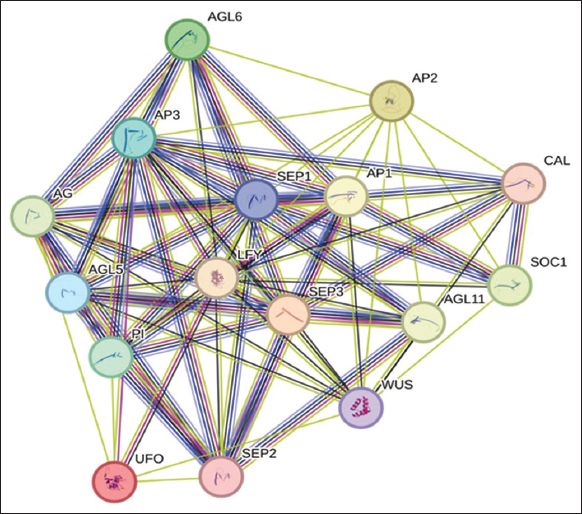 | Figure 2: Protein–protein interaction networks of the 32 putative floral homeotic genes deciphered by the STRING online tool. Network nodes (bold circles) represent proteins. Edges (lines) show protein-protein association. The black coloured lines indicate actual interaction between proteins connecting one node to another. PPI enrichment with P: <1.0e-16. [Click here to view] |