
1. INTRODUCTION
Channa striata (Bloch, 1793), also known as striped snakehead or murrel, is a freshwater species widely cultured in South and Southeast Asia, due to its faster growth rate, good-quality flesh (with minimal spines), and medicinal attributes such as wound healing and post-operative recovery [1]. For many years, fish meal-based diets have been considered the best to fulfil the dietary protein requirement of C. striata since it is a carnivorous fish. And fish meal continues to be the main protein source in aquaculture feeds because of its high digestibility, balanced amino acid profile, good palatability, and growth-promoting attributes [2,3]. Nevertheless, limited supply, rising demand, and the costs of fish meal have created significant apprehensions regarding its long-term sustainability and economic accessibility.
These circumstances have sped up extensive investigations into alternative protein sources, especially those derived from plant-based ingredients, because plant-based protein sources are widespread, affordable, and ecologically sustainable, which can be used as a partial or complete substitution of fish meal in aquaculture formulations. There are, however, factors that make the plant-based ingredient’s incorporation difficult, such as poor digestibility, amino acid deficiencies, high fiber content, and the presence of anti-nutritional factors, which might adversely affect growth performance, nutrient absorption, and overall fish health [3,4]. Therefore, finding suitable and nutritionally balanced plant-based protein sources is still a critical goal of aquaculture nutritional studies.
Duckweed, a tiny free-floating aquatic macrophyte belonging to the family Lemnaceae, is being recognized as a potentially viable alternative protein source for aquaculture. This plant is distinguished by its rapid proliferation, high protein concentration (30%–45%), advantageous amino acid composition, low lignin content, and superior digestibility relative to terrestrial plant proteins [5,6]. It can also be grown using nutrient-rich wastewater and requires minimal land and resources, making it an environmentally sustainable option. Furthermore, duckweed contains important nutrients such as vitamins, minerals, carotenoids, and other beneficial compounds that can support fish growth and health [6]. In contrast with most of the plant-based proteins, duckweed remains a natural protein source that is more equivalent to animal protein and has a wider range of essential amino acids [7].
Recent studies have demonstrated that dietary supplementation with Lemna minor has been shown to improve growth, digestive physiology, and lipid metabolism in common carp (Cyprinus carpio) [8]. Furthermore, diets incorporating duckweed (Spirodela polyrhiza) have been documented to enhance muscle composition, antioxidant capabilities, and immune responses in grass carp [9], thereby highlighting its functional advantages that extend beyond mere nutritional value. According to a systematic review [10], duckweed has been used in aquaculture systems with at least eighteen fish species. The majority of these research concentrates on herbivorous or omnivorous fish; however, studies involving carnivorous fish species remain scarce and inconsistent, highlighting a significant research gap. For instance, in fish species like rainbow trout (Oncorhynchus mykiss), partial substitution of L. minor for conventional protein sources can preserve or even enhance growth performance and product quality [11]. Similarly, S. polyrhiza-based diets have demonstrated some success in carnivorous rainbow trout (O. mykiss), where moderate fishmeal replacement was achievable without appreciable growth reductions, but only at optimal inclusion levels. On the other hand, even moderate inclusion levels of duckweed led to decreased growth performance in other carnivorous species, such as Eurasian perch (Perca fluviatilis), suggesting species-specific restrictions in using plant-based proteins [12]. Despite the economic and ecological importance of snakehead fishes (Channa sp.), which are carnivorous and widely cultured in Asia, there is limited information on the use of duckweed in their diets, particularly for C. striata. This highlights the significance and originality of the current work, and the gap also emphasizes the need for further investigation to determine the appropriate levels of L. minor inclusion and its effects on growth performance and feed utilization efficiency.
It is hypothesized that partial substitution of L. minor for fishmeal may promote growth performance and feed utilization in C. striata without significantly compromising growth performance, as long as inclusion levels are optimized. Consequently, the present study was undertaken to evaluate the impacts of graded substitution of fish meal with duckweed (L. minor) on growth performance, feed utilization, body nutrient deposition, and water quality in C. striata fingerlings. The outcomes of this study will help provide valuable insights into the advancement of sustainable aquafeed methodologies and reducing reliance on traditional fish meal protein sources.
2. MATERIALS AND METHODS
2.1. Ethical Approval
The animal-related experimental procedures were examined and authorized by the Animal Research Ethics Committee of the University (IPS/IAEC/348/23). The use and care of laboratory animals were rigorously adhered to in accordance with national and institutional guidelines for each technique.
2.2. Experimental Diet Formulation and Proximate Analysis
Lemna minor (a floating freshwater macrophyte with one, two, three, or four light or dark green, oval-shaped fronds that are typically 1–5 mm in length, with three to five veins, each having a single 1–2 cm long hanging root) was harvested from the community pond of a nearby village of the institute. It was then washed, sun-dried for 2 days, and ground into a fine powder using a mixer grinder. Before preparing diets, the proximate composition of L. minor was checked, and 8.14 ± 0.34 moisture, 42.61 ± 0.24 crude protein, 6.84 ± 0.31 crude fat, 5.36 ± 0.23 crude fiber, and 10.24 ± 0.04 total ash % were observed; then, keeping in mind the protein %, fish meal with 42% crude protein was purchased. Five diets were formulated by progressively replacing fish meal with dried L. minor at 0%, 25%, 50%, 75%, and 100% levels, designated as D1, D2, D3, D4, and D5, respectively. The control group was served by a commercially available feed (CF) commonly employed by farmers. Diets were formulated using two sustainable and inexpensive protein sources, groundnut oil cake and L. minor, another protein source, fish meal, two carbohydrate sources and binders, i.e., wheat flour and rice bran, cod liver oil as lipid source and feeding stimulant, mineral premix (Nutrimin growth enhancer, which contains, L-lysine, DL-methionine, vitamin C, vitamin A, vitamin D3, choline chloride, inositol, manganese, zinc, iron, iodine, cobalt, and selenium), and chromic oxide (Table 1). All ingredients were finely ground, mixed thoroughly, excluding fish meal, oil, mineral mixture, and the dough was kneaded using lukewarm distilled water. Then, the dough was steam-cooked for 15 minutes to reduce anti-nutritional factors and to improve gelatinization. After cooling the dough, the rest of the ingredients were mixed, and the dough was compressed and molded into uniform feed pellets (diameter = 0.5 mm) with the help of a manual pelletizer. Pellets were dried in an incubator universal (Make, NSW-151) at 50°C for 15 hours. Diets were stored in airtight containers. The standard AOAC [13] procedures were followed to analyze the crude protein, lipid, ash, crude fiber, nitrogen-free extract (NFE), and gross energy of the diets. All experimental diets were isonitrogenous and isocaloric.
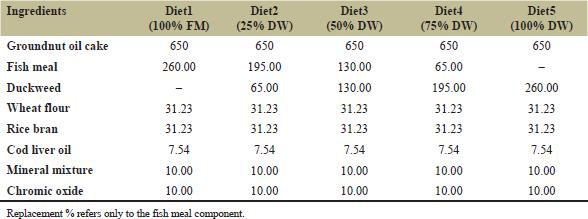 | Table 1. Ingredients composition (g Kg-1) of experimental diets. [Click here to view] |
2.3. Experimental Fish, Rearing Conditions, and Feeding Protocol
Channa striata fingerlings (approx. 3 g) had been accustomed for 15 days before experimentation. A natural photoperiod (12L:12D) was followed. Fish were maintained in a continuously aerated dechlorinated tap water in a 40-L plastic tank at a density of 10 individuals, with three replicates for each dietary group (model is consistent with commonly adopted aquaculture nutrition practices [14–16]). The water was replenished daily at a rate of 30%–40%, and water quality analysis were performed on a weekly basis. For a period of 90 days, the fish were fed respective diets at a rate of 6% of their body weight per day in two equal instalments (9:00 and 17:00). The feed ration was adjusted in accordance with the recorded body weight at biweekly intervals.
2.4. Growth and Feed Utilization Parameters
Live weight gain, percentage weight gain, growth per day, specific growth rate (SGR), feed conversion ratio (FCR), gross conversion efficiency (GCE), and protein efficiency ratio (PER) were assessed using standard formulae to assess growth performance
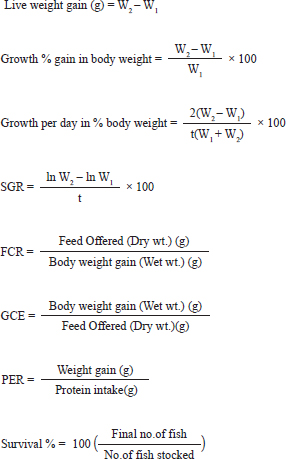
where W1 = initial weight (g), W2 = final weight (g), and t = No. of days of experiment.
The water level in the tanks was gradually reduced prior to the fish being weighed. The fish were temporarily stored in a lidded container after being collected using a scoop net. The fish was dried using tissues and moved individually with a soft cloth. Its weight was measured. Then, the fish were put back in their respective tanks.
2.5. Water Quality and Nutrient Excretion
Temperature, pH, dissolved oxygen (DO), alkalinity, chloride, calcium, and total dissolved particulates were periodically monitored as water quality parameters according to APHA [17] to monitor the effect of feed on water aspects. Excretory levels of total ammonia (N-NH4) and orthophosphate (o-PO4) were investigated, and the abundance of nitrogen and phosphate excreted by fish in holding water was determined as follows:

where C1 and C2 = initial and final concentrations (mg l-¹), V = water volume (L), W = fish biomass (kg), and t = time (hours converted to days). Units: mg kg-¹ body weight (BW) day-¹.
2.6. Carcass Composition
At the end of the trial, three fish from each treatment were anaesthetized using MS-222, and whole-body fish carcass samples were analyzed for moisture, crude protein, lipid, ash, and gross energy in accordance with the AOAC [13] methodology.
2.7. Cost–Benefit Assessment
The market price of live C. striata was considered 600 Rs/kg for economic assessment. The profitable assessment of the diets was evaluated by the method suggested by New [18], which is described as follows:

2.8 Statistical Analysis
The data were presented as mean ± SE. Normality and homogeneity of variance of raw data were assessed using the Shapiro–Wilk p-value and Levene’s test, respectively. To ascertain statistically significant differences among treatments (p < 0.05), one-way ANOVA was implemented, followed by Tukey's post hoc test. All statistics were done using SPSS Version 16.0.
3 RESULTS
3.1. Proximate Composition of Diets
All experimental diets contained approximately 40% crude protein and 14 kJ g-¹ gross energy, confirming isonitrogenous and isocaloric formulation with no significant differences (p > 0.05) observed in crude protein, crude fat, or gross energy among treatments. However, crude fiber content increased significantly with increasing duckweed inclusion, with the highest value in D5 (7.50%), followed by D4, D3, D2, and D1, while the lowest value was recorded in CF (3.46%). Conversely, total ash and moisture content were significantly higher (p < 0.05) in CF than in all lab-prepared diets (D1–D5). NFE showed variation, with D1 exhibiting the highest value, significantly higher than D4 and D5, while other treatments remained comparable (Table 2).
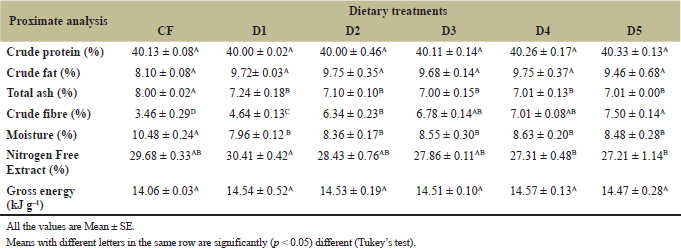 | Table 2. Proximate analysis of commercially available feed and formulated feed (CF = commercial feed, D1 = 100% fish meal, D2 = 75% fish meal, D3 = 50% fish meal, D4 = 25% fish meal, D5 = 100% duckweed). [Click here to view] |
3.2. Growth Performance
Fish fed CF exhibited the highest final weight (14.38 ± 0.03), live weight gain (11.34 ± 0.04), and SGR (1.72 ± 0.0), all significantly higher (p < 0.05) than the lab-prepared diets. Among laboratory-prepared diets, D2 resulted in significantly higher final weight (12.5 ± 0.06), weight gain (9.48 ± 0.05), and SGR (1.56 ± 0.00) compared to other duckweed-based diets (p < 0.05). D1 showed a significantly lower growth rate than D2 but higher than D3, D4, and D5. Growth performance declined progressively as duckweed levels increased beyond D2, with D5 showing the lowest growth indices (final weight: 5.14 ± 0.08, live weight gain: 2.09 ± 0.08, and SGR: 0.58 ± 0.02). Survival rate remained relatively high and statistically comparable (p > 0.05) among CF, D1, D2, and D3 treatments but decreased significantly in D5 (50% survival: indicating possible negative effects of just plant protein), while D4 exhibited intermediate values, as shown in Table 3.
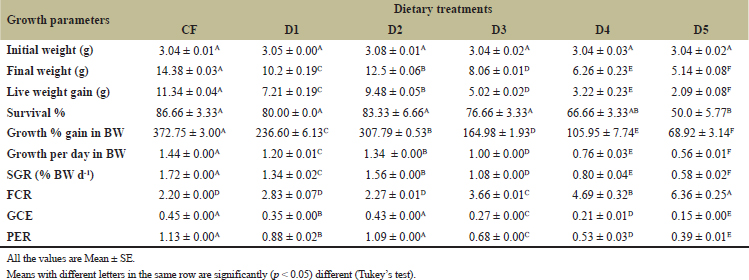 | Table 3. Effect of various diets on the growth performance of C. striata fingerlings after a period of 90 days. [Click here to view] |
3.3. Feed Utilization
FCR increased significantly with increasing duckweed inclusion, with the lowest (best) values observed in CF (2.20 ± 0.00), D1 (2.83 ± 0.07), and D2 (2.27 ± 0.01) (no significant difference among them), followed by D3 and D4, while D5 (6.36 ± 0.25) recorded the highest (worst) FCR. PER and GCE showed a reverse trend with CF (PER 1.13 ± 0.00, GCE: 0.45 ± 0.00) and D2 (PER: 1.09 ± 0.00, GCE: 0.43 ± 0.00), showing significantly higher values, followed by D1, while more than 25% duckweed inclusion levels (D3, D4, and D5) resulted in poorer PER and GCE, reaching the lowest value in D5 (PER: 0.39 ± 0.01, and GCE: 0.15 ± 0.00), indicating poor feed efficiency.
3.4. Water Quality and Nutrient Excretion
Most water quality parameters stayed within acceptable limits during the experiment. DO was significantly higher in CF (6.29 ± 0.13), D1 (6.06 ± 0.06), and D2 (6.39 ± 0.16) compared to D4 (5.09 ± 0.29) and D5 (lowest value: 4.86 mg l-¹, although still within acceptable ranges), while D3 showed an intermediate value. The pH remained within a narrow range (7.10–7.80), with CF and D2 showing significantly higher values than D3, D4, and D5. Temperature (~27.35°C) and chloride levels (~35.50) did not differ significantly among treatments. Alkalinity increased significantly with increasing duckweed inclusion, with the highest values recorded in D5 (170.44 ± 1.01), followed by D4 and D3, while CF (133.09 ± 1.32) showed the lowest. Moreover, total dissolved solid values and the amount of ammonia and orthophosphate excretion escalated significantly (p < 0.05), with the highest amounts seen in D5 (TDS: 351.68 ± 11.28, ammonia: 1139.4 ± 12.99, orthophosphate: 296.42 ± 2.95), followed by D4, D3, D1 and D2, while the lowest was observed in CF (TDS: 190.37 ± 10.23, ammonia: 737.47 ± 5.16, orthophosphate: 101.88 ± 2.57) (Table 4).
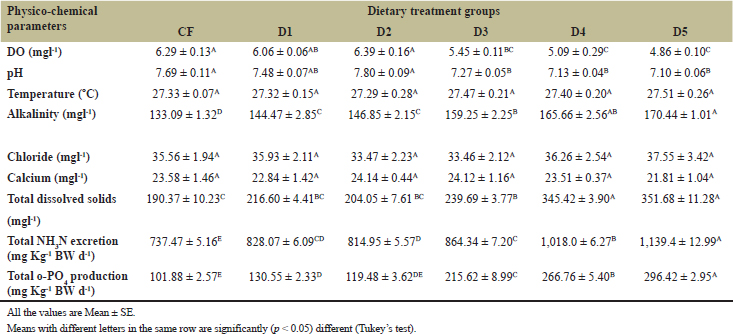 | Table 4. Effect of different dietary supplementation on water quality parameters. [Click here to view] |
3.5. Carcass Composition
Carcass composition of fingerlings (Table 5) showed significant variation among treatments. In comparison to other treatments, fish that were fed CF and D2 exhibited a higher carcass protein content (16.64% ± 0.10% and 15.75% ± 0.11%, respectively), followed by D1. While it decreased as the level of duckweed increased in D3 and D4, reaching the lowest value in D5 (6.56% ± 0.26%). Crude lipid content followed a similar trend, with CF and D2 (5.03 ± 0.08 and 4.97 ± 0.12, respectively) showing significantly (p < 0.05) higher values, while D5 (3.38 ± 0.19) had the lowest. On the contrary, moisture (70.46–76.75) content increased significantly with higher duckweed inclusion, indicating poorer nutrient deposition in fish body tissues at higher plant protein levels. Total ash content was lowest in CF, D1, and D2 without a significant difference, highest in D4 and D5, while D3 showed a moderate value. Gross energy content also declined significantly from CF (6.59 ± 0.02 kJ g-¹) to D5 (3.82 ± 0.07 kJ g-¹); however, CF and D2 showed no significant differences between them.
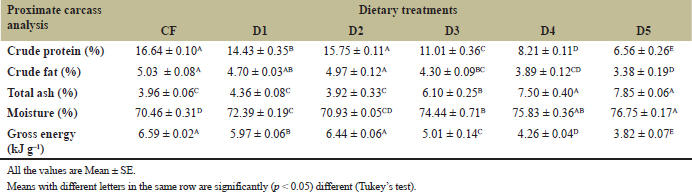 | Table 5. Proximate carcass composition of experimental fish fed on the respective diet. [Click here to view] |
3.6. Cost–Benefit Analysis
Hi-Pro Murrel fish feed (CMF4083) employed for CF treatment costs approximately 90 Rs/kg. The actual cost of lab-prepared diets exhibited a decreasing trend from D1 to D5 (51.5, 50, 46, 44, 41.5 Rs/kg, respectively) due to the replacement of costly fish meal with inexpensive duckweed. While the incidence cost values of lab-prepared diets, including D1 and moderate levels of duckweed substitution (D2 and D3), were significantly lower than those of commercially available feed (CF), typically utilized by farmers for snakehead cultivation. Nevertheless, the values escalated significantly (p < 0.05) with greater duckweed inclusion (D4 and D5) owing to the inadequate utilization of a diet comprising higher plant proteins by carnivorous fish. The profit index was highest in the D2 (5.27 ± 0.02) treatment, followed by D1, D3, CF, and D4, with the lowest value recorded for the D5 group (Table 6).
 | Table 6. Economic assessment of C. striata fingerlings fed on varying concentrations of L. minor. [Click here to view] |
4 DISCUSSION
The present study evaluated the suitability of plant protein source-based diets as a partial replacement for conventional protein source in the feeding of carnivorous fish C. striata, which typically requires high levels of dietary protein and exhibits a digestive system adapted for efficient utilization of animal-derived proteins. Duckweed has emerged as a promising alternative protein source in aquaculture due to its favorable nutritional profile with a potentiality of replacing costly animal-based proteins in fish feed. According to recent research, the crude protein content of duckweed ranges from 20% to 45%, depending on the species and growing conditions [19]. Lemna minor usually has 35%–45% protein, while Lemna gibba has relatively lower levels (20%–30%), and S. polyrhiza has a range of 30%–40% [20]. Therefore, L. minor was selected for this study, keeping in view its protein content first. It also has a good amino acid profile in addition to its protein level. It contains critical amino acids, including lysine and branched-chain amino acids. Its nutritional value is further increased, and its use as a sustainable feed element is supported by the presence of highly digestible proteins like Rubisco [21]. Another major component of the formulation is groundnut oil cake (GNOC), which is a plant-based, cheap source of protein with crude protein levels usually between 43% and 52%. Its high arginine content and relative lack of sulfur-containing amino acids, such as methionine, may restrict its standalone use in fish diets [22]. GNOC helps to improve overall protein content when coupled with duckweed. Fish meal, rice bran, wheat flour, and cod liver oil are additional feed components that complement each other in the diet. Because of its great digestibility and balanced amino acid makeup, fish meal continues to be the gold standard for protein sources, whereas cereal by-products mainly provide energy and help in binding pellets. Essential fatty acids are supplied via a lipid source, cod liver oil, which also enhances the energy density and palatability of feed. The inclusion of mineral mixture in the diets helped to partially compensate for the deficiencies of vitamins, minerals, and some amino acids. Chromic oxide was added as an inert marker, but digestibility assays were not carried out because it was not incorporated in commercial feed (CF), making it difficult to compare apparent digestibility coefficients reliably. For appropriate evaluation, inactive markers in all diets should be included in future research. Although all diets were formulated to be isonitrogenous and isocaloric, growth and feed utilization responses clearly indicated that protein quality and ingredient composition influenced performance.
In comparison to the other experimental diets, fish fed CF, which is frequently used by farmers, showed the best growth performance, feed utilization, and carcass protein content in this study. This can be clarified through the facts that CFs for carnivorous fish are mainly comprised of fish meal and other animal products like squid meal (also mentioned on the feed bag in the first place, although the exact percentage is not available); second, CFs are carefully prepared with balanced nutrients, processed using cutting-edge methods like extrusion. Such factors help to improve the growth and feed efficiency [23]. Moreover, the lower fiber content in the CF may have also contributed to the better nutrient assimilation and hence growth.
Interestingly, the diet with 25% duckweed (L. minor) inclusion (D2) performed better than the higher fish meal-containing diet (D1) in terms of growth, FCR, PER, and carcass protein content, even though fish meal is thought to be a better source of protein. This improved performance may be attributed to a nutritional interaction between duckweed and the conventional protein source fish meal at optimal inclusion levels. Duckweed may provide additional nutrients such as carotenoids, vitamins, minerals, and bioactive compounds that enhance metabolism and digestion [6]. It may also improve the overall nutrient balance of the diet. These findings are consistent with previous studies, where enhanced growth has been reported following partial substitution of fish meal with duckweed. Oreochromis niloticus fed a diet containing 15% L. minor showed better growth than those fed fishmeal alone [24]. Similar findings have been reported for C. gariepinus, where optimal substitution (40%) of L. minor boosted growth and feed utilization-efficiency, as compared to fish meal-based control [25]. Further research has demonstrated that duckweed species such as L. perpusilla and S. polyrhiza can partially substitute fishmeal in tilapia diets and support growth [26,27]. Moreover, in-depth examinations of duckweed's fiber fractionation, mineral content, and amino acid profile were outside the purview of this investigation. In order to improve diet formulation, these aspects should be included in future research as they may explain the differences between D1 and D2.
On the other hand, increasing duckweed levels beyond 25% resulted in a gradual decline in growth performance, feed efficiency, and carcass quality. Scientists have reported similar findings for different duckweed species in other carnivorous fish, C. gariepinus for L. minor [25], Heterobranchus longifilis for Lemna pauciscostata [28], and Eurasian perch (P. fluviatilis) and rainbow trout (O. mykiss) for S. polyrhiza [29]. This decline may be attributed to several nutritional and physiological factors. First, carnivorous fish like C. striata have shorter digestive systems and are less efficient at digesting plant materials, though duckweed has less fiber than other plant-based ingredients, but adding more of it still makes nutrients harder to digest [4,5]. Second, elevated levels of plant protein have the potential to reduce feed palatability, leading to lower feed intake; however, feed intake was not measured directly in the present study (therefore, this explanation remains speculative). This corresponds with the findings of [30,31], who reported a substantial reduction in feed intake as a result of the L. perpusilla and L. minor incorporation in the diets of C. gariepinus, O. niloticus, and giant freshwater prawns, respectively. In another study [32], a decrease in feed acceptability by O. niloticus was observed as the proportion of L. minor increased to 50%. Free amino acids and nucleotides are natural feeding stimulants found in fish meal that make it more palatable [2]. So, full replacement makes the feed less appealing to be eaten by fish, while partial replacement keeps it tasty enough.
The decrease in carcass protein and lipid content at higher duckweed inclusion levels can be attributed to the fact that heavy fish meal replacement can limit nutrient utilization because of anti-nutritional factors [2–4]. Similar patterns have been reported in C. gariepinus when fed elevated levels of plant protein [25]. At moderate inclusion levels, carcass composition remained relatively better, supported by studies on carp, trout, and tilapia, where optimal incorporation of duckweed has shown effective nutrient deposition [8,11,24]. The reduction in protein and fat deposition is reflected in an increase in moisture content and a decrease in energy content, which is a typical pattern in fish fed a high proportion of plant-based nutrients [8]. Overall, these findings align with existing literature indicating that although duckweed is a good substitute protein source, its usage should be restricted to modest amounts to prevent unwanted effects on carcass quality. Water quality is also a crucial factor in aquaculture, as it directly affects fish health and growth. In this study, most water quality parameters remained within acceptable limits, indicating suitable rearing conditions. DO levels were found to be relatively lower in D5 compared to other treatments, but still, the recorded DO values remained within acceptable limits (>4 mgl-1) for fish growth and survival. Therefore, it is unlikely that the observed decrease had a significant direct impact on growth performance. However, higher duckweed levels led to increased ammonia and phosphorus excretion. This suggests that protein and phosphorus were not efficiently utilized at higher inclusion levels. Excess amino acids are broken down and released as ammonia [33], while plant-based phosphorus (in phytate form) is less digestible and is excreted into water [4]. This can negatively impact water quality and overall efficiency. On the other hand, the lower ammonia excretion seen in CF and D2 suggests better utilization of protein. Furthermore, the cost–benefit analysis showed that the D2 diet was the most economical, with the highest profit index. Although CF supported the best growth, the profit margin was poor because of its higher cost. Partial replacement with duckweed (especially at 25%) offers a good balance between cost and growth performance. Duckweed is an inexpensive and eco-friendly feed product that can be cultivated locally in village ponds using nutrient-rich wastewater [6]. Reducing fish meal usage also helps to lower the pressure on wild fish stocks and promotes sustainable aquaculture practices [34].
Overall, the findings show that, when added in a responsible manner, C. striata fingerlings can utilize plant-based protein sources like duckweed (L. minor) effectively. Other carnivorous fish species have shown comparable adaptability when plant protein is utilized within an optimum range [12,25,28,30]. Therefore, it is not advised to completely replace fish meal with duckweed; however, for snakehead fingerlings culture, integration at an optimal level (25%) can be recommended under the tested experimental conditions. Even though CF provides the best growth performance, the D2 diet offers a good balance between growth, feed efficiency, and economics.
5. CONCLUSION
The study concludes that duckweed (L. minor) can be used as a partial replacement for fish meal in the diet of C. striata fingerlings. Among the lab-prepared diets, 25% L. minor replacement with fish meal resulted in the best growth performance, feed utilization, carcass protein content, and profit index. Higher replacement levels reduced growth and increased nutrient excretion. Therefore, 25% fish meal replacement is recommended for fingerlings under the tested dietary composition and experimental conditions as a cost-effective feeding strategy. However, broader economic and environmental implications require further investigation.
6. ACKNOWLEDGMENT
The authors gratefully acknowledge the facilities provided by the Aquaculture Unit of the University and the financial support provided by the University Grants Commission (UGC), New Delhi, for carrying out this research.
7. AUTHOR CONTRIBUTIONS
All authors made substantial contributions to conception and design, acquisition of data, or analysis and interpretation of data; took part in drafting the article or revising it critically for important intellectual content; agreed to submit to the current journal; gave final approval of the version to be published; and agreed to be accountable for all aspects of the work. All the authors are eligible to be authors as per the International Committee of Medical Journal Editors (ICMJE) requirements/guidelines.
8. CONFLICTS OF INTEREST
The authors report no financial or any other conflicts of interest in this work.
9. ETHICAL APPROVALS
Ethical approval details are given in the ‘Materials and Methods’ section.
10. DATA AVAILABILITY
All the data are available with the authors and shall be provided upon request.
11. PUBLISHER’S NOTE
All claims expressed in this article are solely those of the authors and do not necessarily represent those of the publisher, the editors, or the reviewers. This journal remains neutral with regard to jurisdictional claims in published institutional affiliation.
12. USE OF ARTIFICIAL INTELLIGENCE (AI)-ASSISTED TECHNOLOGY
The authors declare that they have not used artificial intelligence (AI) tools for writing and editing of the manuscript, and no images were manipulated using AI.
REFERENCES
1. Haniffa MA, Marimuthu K. Seed production and culture of snakehead. INFOFISH Int 2004;2:16–8.
2. Hardy RW. Utilization of plant proteins in fish diets. Aquac Res 2010;41(5):770–6; CrossRef
3. Gatlin DM, Barrows FT, Brown P, Dabrowski K, Gaylord TG, Hardy RW, et al. Expanding the utilization of sustainable plant products in aquafeeds. Aquac Res 2007;38(6):551–79; CrossRef
4. Francis G, Makkar HPS, Becker K. Antinutritional factors present in plant-derived alternate fish feed ingredients and their effects. Aquaculture 2001;199(3–4):197–227; CrossRef
5. Leng RA, Stambolie JH, Bell R. Duckweed: a potential high-protein feed resource for domestic animals and fish. Livest Res Rural Dev. 1995;7(1):36.
6. Appenroth KJ, Sree KS, Böhm V, Hammann S, Vetter W, Leiterer M, et al. Nutritional value of duckweeds (Lemnaceae) as human food. Food Chem 2017;217:266–73; CrossRef
7. Hillman WS, Culley DD. The uses of duckweed. Am Sci 1978;66:442–51.
8. Goswami RK, Sharma J, Shrivastav AK, Kumar G, Glencross BD, Tocher DR, et al. Effect of Lemna minor supplemented diets on growth, digestive physiology and expression of fatty acids biosynthesis genes of Cyprinus carpio. Sci Rep 2022;12(1):3711; CrossRef
9. Song Y, Hu Z, Yang X, An Y, Lu Y. Duckweed as a sustainable aquafeed: effects on growth, muscle composition, antioxidant and immune markers in grass carp. Animals. 2026;16(1):53; CrossRef
10. Minich JJ, Michael TP. A review of using duckweed (Lemnaceae) in fish feeds. Rev Aquac 2024;16(3):1212–28; CrossRef
11. Fiordelmondo E, Ceschin S, Magi GE, Mariotti F, Iaffaldano N, Galosi L, et al. Effects of partial substitution of conventional protein sources with duckweed (Lemna minor) meal in the feeding of rainbow trout (Oncorhynchus mykiss) on growth performances and the quality product. Plants 2022;11(9):1220; CrossRef
12. Stadtlander T, Rosskothen D, Tschudi F, Seitz A, Sigrist M, Pietsch C, et al. Duckweed as fishmeal-protein replacement for omnivorous and carnivorous fish fry. In Book of Abstracts of the 72nd Annual Meeting of the European Federation of Animal Sciences, Wageningen Academic Publishers, Davos, Switzerland; 2021. 321 p.
13. AOAC. Official methods of analysis. 18th ed. Washington, DC: Association of Official Analytical Chemists; 2005.
14. Bhatnagar A, Mann D. The synergic effect of gut-derived probiotic Bacillus cereus SL1 and Ocimum sanctum on growth, intestinal histopathology, innate immunity, and expression of enzymatic antioxidant genes in fish, Cirrhinus mrigala (Hamilton, 1822). Probiotics Antimicrob Proteins 2025;17(1):271–91; CrossRef
15. Saluja S, Bhatnagar A. Dietary administration of probiotic Bacillus coagulans and Mentha piperita can protect histological architecture and DNA damage in Catla catla (Hamilton, 1822). Aquac Fish 2024;9(6):948–56; CrossRef
16. Bhatnagar A, Saluja S. Role of Zingiber officinale and autochthonous probiotic Bacillus coagulans in feeds of Catla catla (Hamilton, 1822) for growth promotion, immunostimulation, histoprotection, and control of DNA damage. Fish Physiol Biochem 2021;47(6):2081–100; CrossRef
17. APHA. Standard methods for the examination of water and wastewater. 21st ed. New York: American Public Health Association; 2005.
18. New MB. Formulated aquaculture feeds in Asia: some thoughts on comparative economics, industrial potential, problems and research needs in relation to the small-scale farmer. In: Report of the Workshop on Shrimp and Finfish Feed Development, Johore Bahru, Malaysia, 25–29 October 1988. Manila, Philippines: ASEAN/UNDP/FAO Regional Small-Scale Coastal Fisheries Development Project; 1989. p. 19–30. Report No. ASEAN/SF/89/GEN/11. Available online: https://www.fao.org/4/ac421e/AC421E02.html
19. Sikarwar AS. Application of aquatic macrophytes in aquaculture: a review on aquatic macrophyte in aquafeed and their effects on fish. J Aquac Res Dev 2025;16(1):1000948.
20. Song Y, Hu Z, Liu S, Luo S, He R, Yang X, et al. Utilization of microalgae and duckweed as sustainable protein sources for food and feed: nutritional potential and functional applications. J Agric Food Chem 2025;73(8):4466–82.
21. Çelik B, Özden G. A review on the usability of duckweed as a source of vegetable protein in animal nutrition. In: Proceedings of the 6th International Conference on Environment and Forest Conservation (ICEFC 2025): Nature-Based Solutions for Climate Resilience; 18–21 November 2025; Kastamonu, Türkiye. 2025. p. 364–370.
22. Yadav R, Jayant M, Jana P, Yadav NK, Chadha NK, Saini VP, et al. Effects of substituting groundnut oil cake with Prosopis cineraria seed meal on growth, physio-metabolic, and haemato-biochemical responses of Labeo rohita. Aquac Sci Manag. 2025;2(1):7.
23. Bureau DP, Hua K. Towards effective nutritional management of waste outputs in aquaculture. Aquac Res 2010;41(5):777–92; CrossRef
24. Opiyo MA, Mbogo K, Abwao J, Kyule D, Amahwa C, Nyonje BM, et al. Fishmeal partial replacement using duckweed (Lemna minor) enhances growth performance and body composition of Nile tilapia (Oreochromis niloticus). Sustain Aquat Res 2024;3(3):127–36; CrossRef
25. Irabor AE, Obakanurhie O, Nwachi FO, Ekokotu PA, Ekelemu JK, Awhefeada OK, et al. Duckweed (Lemna minor) meal as partial replacement for fish meal in catfish (Clarias gariepinus) juvenile diets. Livest Res Rural Dev 2022;34(1): Available link: https://www.lrrd.org/lrrd34/1/3406irabo.html
26. Hassan MS, Edwards P. Evaluation of duckweed (Lemna perpusilla and Spirodela polyrrhiza) as feed for Nile tilapia (Oreochromis niloticus). Aquaculture 1992;104:315–26; CrossRef
27. Fasakin EA, Balogun AM, Fasuru BE. Use of duckweed, Spirodela polyrrhiza L. Schleiden, as a protein feedstuff in practical diets for tilapia, Oreochromis niloticus L. Aquac Res 1999;30(5):313–8.
28. Effiong BN, Sanni A, Fakunle JO. Effect of partial replacement of fishmeal with duckweed (Lemna pauciscostata) meal on the growth performance of Heterobranchus longifilis fingerlings. Rep Opin 2009;1:76–80.
29. Stadtlander T, Tschudi F, Seitz A, Sigrist M, Refardt D, Leiber F. Partial replacement of fishmeal with duckweed (Spirodela polyrhiza) in feed for Eurasian perch and rainbow trout. Aquac Res 2023;2023:6680943; CrossRef
30. Méndez-Martínez Y, Perez Tamames Y, Cortes-Jacinto E. Effect of duckweed meal dietary inclusion on growth performance and survival of African catfish fingerlings. Rev Fac Agron (LUZ) 2021;38(1):84–104; CrossRef
31. Irabor AE, Adeleke LM, Pierre HJ, Nwachi FO. Performance of Nile tilapia (Oreochromis niloticus) with giant freshwater prawns (Macrobrachium rosenbergii) fed diets with duckweed (Lemna minor) and fish waste meal. Livest Res Rural Dev 2022;34(8): Available from: https://lrrd.cipav.org.co/lrrd34/8/3473irab.html
32. Olaniyi CO, Oladunjoye IO. Replacement value of duckweed (Lemna minor) in Nile tilapia (Oreochromis niloticus) diet. Transnatl J Sci Technol 2012;2(9):54–62.
33. Cho CY, Bureau DP. A review of diet formulation strategies and feeding systems to reduce excretory and feed wastes in aquaculture. Aquac Res 2001;32:349–60; CrossRef
34. FAO. The State of World Fisheries and Aquaculture. Food and Agriculture Organization of the United Nations, Rome, Italy, 2022.