
1. INTRODUCTION
Garlic essential oil (GEO) is a natural source that is rich in volatile sulfur compounds. It is famous for strong biological activities such as antibacterial, anti-inflammatory, antioxidant, and antifungal capacity [1]. Due to these characteristics, GEO is a potential natural food additive for improving flavor and preservation. However, sulfur compounds of GEO are unstable and easily lost during processing and storage. Therefore, this instability prevents its direct use in industrial food applications [2].
To solve these problems, microencapsulation is an effective strategy to protect sensitive bioactive compounds. It can minimize flavor loss and control the release of the active compounds [2]. Among various microencapsulation methods, spray drying is widely used in the food industry because it is simple, cheap, and suitable for large-scale production. In addition, understanding how GEO is released from microcapsules is important in real food making. Environmental factors such as temperature and relative humidity (RH) can strongly influence the release process. The Avrami kinetic method is commonly used to describe release behavior and to explain the related release mechanisms. By linking Avrami parameters with storage conditions, it is possible to predict product stability and performance in food systems [3,4].
Nem chua Hue is a traditional Hue fermented pork product and famous for its distinctive aroma and taste. Like other kinds of Nem chua in other places of Vietnam, Nem chua Hue has a quite short shelf-life. Therefore, adding GEO microcapsules into Nem chua Hue could give some benefits, such as extending its shelf-life via antimicrobial activity and alleviating the pungent odor intensity that comes from fresh garlic – the topping in Nem chua Hue. This approach could enhance both food safety and consumer acceptability. Although microencapsulation of essential oils has been studied in many previous researches, application of GEO microcapsules in a traditional fermented product like Nem chua Hue is still limited, especially in the Vietnamese context.
Carrier materials or wall materials play a key role in encapsulation by protecting the core, controlling the release, and applying in food systems. Previous studies have shown that combinations of maltodextrin (MD) and cyclodextrins (CDs) are good for improving encapsulation efficiency and functional properties. For example, MD–CD systems have been used to reduce bitterness in whey protein hydrolysates [5], protect phenolic compounds [6], and keep color stability in fruit juices [7]. Therefore, using a dual-carrier system is expected to improve both encapsulation efficiency and functional performance of GEO. Accordingly, the present study was designed with the following specific objectives:
(i) To optimize the encapsulation process of GEO by spray drying
(ii) To evaluate the retention of the bioactivity of microencapsulated GEO (MGEO)
(iii) To model the release kinetics using the Avrami equation and establish the relationship between kinetic parameters and RH/temperature conditions
(iv) To apply the obtained powder to Nem chua Hue to assess its effectiveness in extending its shelf-life and sensory acceptability.
By addressing both fundamental and applied aspects, this study contributes to the development of safe, high-quality, and economically valuable food products. Furthermore, it provides a robust methodological framework for integrating natural bioactive compounds into functional foods, aligning with global efforts toward sustainable food preservation and reducing reliance on synthetic additives.
2. MATERIALS AND METHODS
2.1. Materials
Garlic was collected from Chieng Dong commune, Yen Chau district, Son La province (Vietnam). Garlic was finely ground and mixed with water at a ratio of 1:3. The mixture was sonicated for 10 min and then subjected to hydrodistillation for 3 h. The GEO was contained in a dark-colored bottle and stored in a fridge before doing encapsulation experiments.
The ingredients for Nem chua Hue preparation, including pork meat, pork skin, spices, and banana leaves, were procured from local suppliers. MD (DE = 10–12, moisture content 3–5%), α-CD, and γ-CD (Wacker Chemical Corp., USA; moisture content 3–5%) were employed as wall materials. Analytical grade reagents, potassium sulfate (K2SO4), sodium chloride (NaCl), potassium carbonate (K2CO3), and silica gel, were also used.
2.2. Equipment
Some main equipment used for this research are presented in Table 1S.
2.3. Analysis Methods
2.3.1. Chemical Composition Analysis of GEO
GEO was collected by hydrodistillation with the conditions mentioned in 2.1. Gas chromatography-mass spectrometry (GC-MS) analysis of the chemical composition was performed using a DB-1 capillary column (30 m × 250 μm × 0.25 μm). The injection port was maintained at 250°C, with a 1 μL injection volume, helium as the carrier gas at a flow rate of 1 mL/min. The oven temperature was programmed as follows: An initial temperature of 45°C (held for 0 min), followed by an increase at 5°C/min–150°C (held for 0 min), and then a ramp of 40°C/min–290°C (held for 5 min). Mass spectrometric detection was conducted in scan mode over an m/z range of 30–500, with the MS source and quadrupole temperatures set at 230°C and 150°C, respectively.
2.3.2. Microencapsulation of GEO by Spray Drying
GEO was blended with the solution of the carrier materials (α-CD, γ-CD, a mixture of MD and α-CD, or a mixture of MD and γ-CD) at specified ratios (2%, 5%, and 8% GEO) and distilled water. The mixture was homogenized before spray-drying at different inlet temperatures (160–180°C) with a rotary atomizer.
2.3.3. Characteristics of MGEO Powder
The characteristics of MGEO powder were evaluated through several analytical parameters. Moisture content was determined using the gravimetric method, while solubility was assessed following the procedure of Eastman and Moore [8]. Encapsulation yield was defined as the ratio of encapsulated essential oil amount in microcapsule and initial essential oil amount. Encapsulation efficiency was calculated from the proportion of essential oil retained within the microcapsules relative to the added initial amount [9], with the essential oil content quantified by measuring absorbance at 308 nm using a ultraviolet-visible spectrophotometer. Structural properties of the microcapsules were further examined using fourier-transform infrared spectroscopy (FT-IR), thermogravimetric analysis (TGA), X-ray diffraction (XRD), microscopy, and scanning electron microscopy (SEM).
2.3.4. Release Kinetic Studies
2.3.4.1. Experimental Setup
The MGEO powders (0.1 g) were put into glass vials covered by perforated aluminum foil and then were stored in sealed plastic chambers (29.5 cm × 19.5 cm × 20 cm) at different RH and temperature (T) conditions [10]. The RH levels of 6%, 40%, 75%, and 98% were maintained using silica gel, saturated salt K2CO3, saturated salt NaCl, and saturated salt K2SO4, respectively, for a period of 13 days [11,12]. The MGEO powders were taken out of the plastic box at specific intervals and estimated the remaining GEO content.
Similarly, to investigate the effect of temperature, the MGEO powders were stored under ambient RH conditions and subjected to three temperature levels: 30°C, 65°C, and 100°C. The storage experiment was conducted over a period of 35 days.
2.3.4.2. Modeling
The release data were fitted using the Avrami model to calculate the kinetic constants k and n. This model was used to explain the release mechanisms and their relationship with RH and temperature [3].
2.3.5. Application to Nem chua Hue
The experimental design includes preparing Nem chua Hue samples that were supplemented with MGEO at concentrations of 0.01%, 0.015%, and 0.02%. Meanwhile, the controlled samples contained a slice of fresh garlic (like the original method).
Physicochemical properties, including pH and firmness, were measured during the fermentation and storage periods. Microbiological assessments were done by counting total aerobic bacteria, lactic acid bacteria (LAB), and yeasts and molds. Sensory evaluation was conducted using a 9-point Hedonic scale (1 = dislike extremely, 9 = like extremely) to score color, aroma, texture, taste, and overall acceptability. The sensory panel consisted of 40 individuals (aged 18–23) who were familiar with Nem chua Hue. The panelists were briefly trained before evaluation to ensure consistency in scoring. Samples were labeled with three-digit random codes and presented in a randomized order to minimize bias. Evaluation was performed in individual booths, and water was provided between samples as a palate cleanser [13].
2.4. Statistical Analysis
The experiments were all carried out in triplicate, and the data were analyzed using OriginPro 2024 and IBM the Statistical Package for the Social Sciences Statistics 20. Analysis of variance, followed by Duncan’s multiple range test, was used to determine statistically significant differences among samples. Release kinetic parameters were obtained by fitting the experimental data to Avrami model.
3. RESULTS AND DISCUSSION
3.1. Components of GEO
GC-MS analysis showed that the GEO contained organosulfur compounds that are typically found in GEO. The major constituents included di-2-propenyl trisulfide (DATS, 20.42%), diallyl disulfide (DADS, 11.07%), and methyl 2-propenyl trisulfide (11.24%), along with other dithiine and tetrasulfide derivatives, as can be seen in Table 1. These findings mean that trisulfide and disulfide compounds are the characteristic and predominant components of the GEO in this study.
Table 1: Major sulfur volatiles of garlic essential oil (GEO) identified by gas chromatography-mass spectrometry (GC-MS)
| No | Retention time (min) | Peak area*(%) | Component |
|---|---|---|---|
| 9 | 13.094 | 20.42 | Di-2-propenyl trisulfide |
| 2 | 5.933 | 11.07 | Diallyl disulfide |
| 7 | 12.419 | 11.24 | Methyl 2-propenyl trisulfide |
| 21 | 19.866 | 6.4 | 2-Vinyl-4H-1,3-dithiine |
| 20 | 19.441 | 5.2 | 3-Vinyl-1,2-dithiacyclohex-4-ene |
| 11 | 14.473 | 5.02 | Di-2-propenyl tetrasulfide |
| 8 | 12.922 | 3.95 | Allyl propyl trisulfide |
| 15 | 15.977 | 3.74 | (Z)-1-Allyl-2-(prop-1-en-1-yl) disulfane |
| 3 | 7.396 | 3.72 | Allyl methyl disulfide |
| 18 | 19.159 | 3.14 | 1,2-Dithiolane |
* Peak areas were normalized to 100%
Based on the composition, DATS, methyl 2-propenyl trisulfide, and DADS were the major compounds. These organosulfur substances are famous for their strong biological activities, such as antioxidant, anticancer, and antimicrobial effects. The high content of trisulfide and tetrasulfide derivatives (including DATS, methyl-2-propenyl trisulfide, di-2-propenyl tetrasulfide, and allyl propyl trisulfide) means that the GEO is rich with its multi-sulfur compounds, and these compounds are generally more biologically active than disulfides.
In addition, the presence of 2-vinyl-4H-1,3-dithiine and 3-vinyl-1,2-dithiacyclohex-4-ene is also remarkable for contributing both to the characteristic aroma and to the pharmacological properties of garlic. Minor constituents (e.g., allyl methyl disulfide and 1,2-dithiolane), although present at low levels but they may still play an important role due to synergistic effects. Dehariya et al. reported that GEO extracted using the Soxhlet system with ethanol contained the same major compounds as those found in this study, although the proportions were different. In their work, DADS, DAS, and allyl methyl trisulfide were the major components, while DATS accounted for only 3.46% [14]. In the same way, Satyal et al. also identified DADS, DATS, and allyl methyl trisulfide as the main compounds in GEO. Differences in composition and relative content may come from differences in extraction methods and origin of the raw material [15].
3.2. Effect of Encapsulation Parameters on the Quality of MGEO Powder
3.2.1. Effect of Wall Material
The effect of wall material type on the physical properties and encapsulation efficiency of MGEO powders was presented in Table 2. Moisture content can be seen from 1.24% to 1.79%, with MD−α-CD having the highest value (1.79%) and α-CD alone showing the lowest (1.24%). Solubility can be found from 78.27% to 86.00%, and MD−γ-CD showed the highest solubility. This result was significantly higher than that of α-CD and γ-CD alone. These findings mean that combining MD with CD, especially MD and γ-CD, can improve the solubility and maintain moisture content at low level.
Table 2: Effect of encapsulation parameters on the physical properties and encapsulation efficiency of MGEO powders
| Affecting factor | Moisture content (%) | Solubility (%) | Encapsulation yields (%) | Encapsulation efficiency (%) |
|---|---|---|---|---|
| 1) Type of wall material (added GEO 2% (w/w), inlet SD temperature 160?) | ||||
| α-CD | 1.24±0.10a | 78.26±0.66a | 55.10±0.43a | 65.24±0.69a |
| α-CD: MD | 1.79±0.06c | 84.60±0.72c | 62.76±1.49b | 74.09±1.02b |
| γ-CD | 1.67±0.03c | 82.06±0.81b | 56.05±0.21a | 66.39±0.24a |
| γ-CD: MD | 1.49±0.10b | 86.00±1.00c | 79.26±0.39c | 93.68±0.12c |
| 2) Added GEO ratio (%) (wall material γ-CD:MD = 1:2; inlet SD temperature 160?) | ||||
| 2 | 1.30±0.17a | 86.40±0.40b | 80.73±1.41b | 94.07±1.62b |
| 5 | 1.42±0.12a | 86.06±0.66b | 79.20±0.80b | 90.80±1.44a |
| 8 | 1.35±0.09a | 82.23±0.87a | 73.16±1.34a | 89.75±0.78a |
| 3) Inlet SD temperature (wall material γ-CD:MD = 1:2, added GEO 5% (w/w)) | ||||
| 160 | 1.34±0.18a | 86.06±0.66b | 79.33±1.80ab | 90.40±2.11b |
| 170 | 1.22±0.15a | 86.46±0.90b | 80.53±1.28b | 91.86±1.15b |
| 180 | 1.17±0.18a | 82.80±0.60a | 76.50±1.31a | 88.93±1.62a |
a,b,cIndicates the differences between values (P<0.05) in column with each parameter. MGEO: Microencapsulated garlic essential oil, GEO: Garlic essential oil, MD: Maltodextrin, CD: Cyclodextrin, SD: Spray drying
Encapsulation efficiency and yield are also affected by wall material. The MD−γ-CD system showed the highest efficiency (93.68%) and yield (79.26%) (P < 0.05), while α-CD and γ-CD used individually resulted in lower values. These findings demonstrate that a combination of MD and γ-CD significantly improves encapsulation efficiency. This result highlights the importance of wall material combinations.
The higher encapsulation efficiency and yield observed in the MD–CD systems can be explained by the synergistic effect between the two wall materials. CD can trap volatile essential oil compounds through inclusion complex formation, while MD forms a protective film that reduces oil loss during spray drying [16,17]. In addition, MD reduces stickiness and powder adhesion to the dryer walls, which improves powder recovery and overall process efficiency [18,19]. Therefore, the combination of MD and γ-CD is a suitable wall material for encapsulating GEO.
3.2.2. Effect of Added GEO Ratio
The results in Table 2 showed increasing the added GEO content from 2% to 8% did not affect the moisture of MGEO powders (P < 0.05), while solubility decreased from 86.40% to 82.23%. This suggests that higher oil loads can reduce the solubility of the powder.
At 2% GEO, the encapsulation efficiency and yield were the highest (94.07% and 80.70%), but both values declined as the added GEO content increased to 8% (89.75% and 73.16%). This finding means an excessive amount of GEO negatively affects the formation of a stable microcapsule. Increasing oil content beyond an optimal level often leads to the reduction of encapsulation efficiency because of emulsion instability and insufficient wall material [19,20]. Therefore, a GEO ratio of 2–5% was considered an optimal parameter for obtaining MGEO with high solubility, encapsulation yield, and encapsulation efficiency simultaneously.
3.2.3. Effect of Inlet Spray Drying Temperature
It can be seen from Table 2, moisture content of MGEO powder decreased with the increasing of the inlet temperature from 160°C to 180°C. These results are similar to previous studies, which reported that water evaporation enhanced at higher spray drying temperatures [19,21]. However, at 180°C, its solubility and encapsulation yield decreased significantly, suggesting that excessive thermal stress could negatively affect the matrix and powder reconstitution properties. Encapsulation efficiency reached its highest value at 170°C but declined at 180°C, likely due to increased surface oil and partial loss of volatile compounds under rapid crust formation and thermal degradation. Therefore, an inlet temperature of 170°C was identified as optimal, providing a favorable balance between moisture content, solubility, yield, and encapsulation efficiency.
From all results at Table 2, MD−γ-CD, 5% GEO supplement, and spray drying temperature of 170°C are suitable encapsulation parameters to balance moisture content, solubility, encapsulation yield, and encapsulation efficiency.
3.3. Characteristics of MGEO Powder
Based on Figure 1a, the MGEO powder appears as fine, ivory-colored particles, indicating successful matrix formation after the drying process. From visual observation, the powder is relatively homogeneous, and there are no signs of burning or discoloration, suggesting good control over drying conditions. Microscopic and SEM observations showed that the MGEO powders were solid, spherical particles with smooth or wrinkled surfaces [Figure 1b and c]. Particle size is mostly 10–20 μm, and it is a general morphology as for spray-dried microcapsules.The FT-IR spectrum in Figure 1d displays characteristic signals at 3,407 cm−1 (–OH, –NH), 2,925 cm−1 (C–H), 1,649 cm−1 (C=O, C=C), 1,160–1,024 cm−1 (C–O–C, C–OH), and the fingerprint region at 933–525 cm−1. These bands confirm the presence of polysaccharides (MD), CD, and organic functional groups from GEO. Minor peak shifts and changes in intensity variation indicated inclusion and/or hydrogen-bond interactions between the GEO and the carrier matrix.
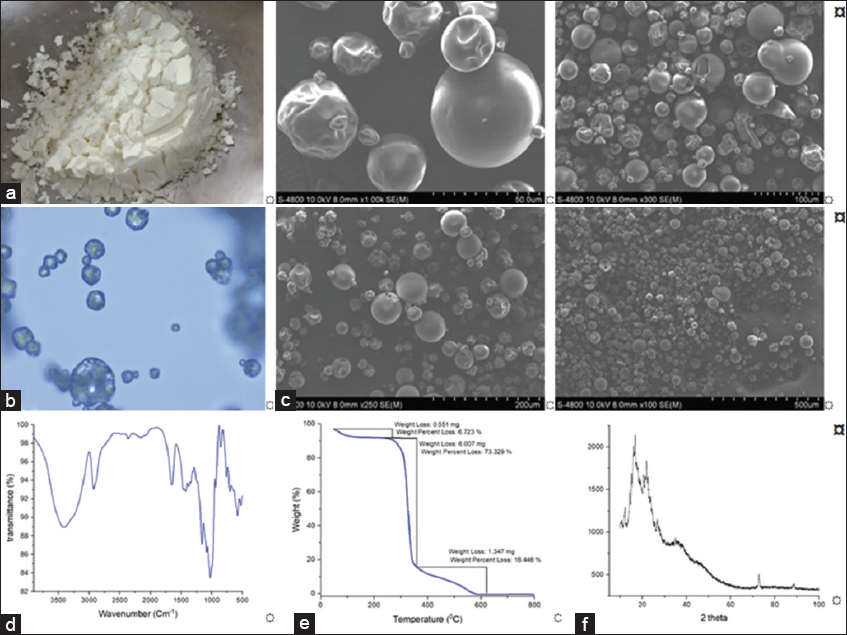 | Figure 1: Characteristics of microencapsulated garlic essential oil (MGEO) powder. (a) MGEO powder, (b) Optical microscopy images, (c) Scanning electron microscopy images, (d) Fourier-transform infrared spectroscopy spectrum, (e) Thermogravimetric analysis curve, (f) X-ray diffraction pattern. [Click here to view] |
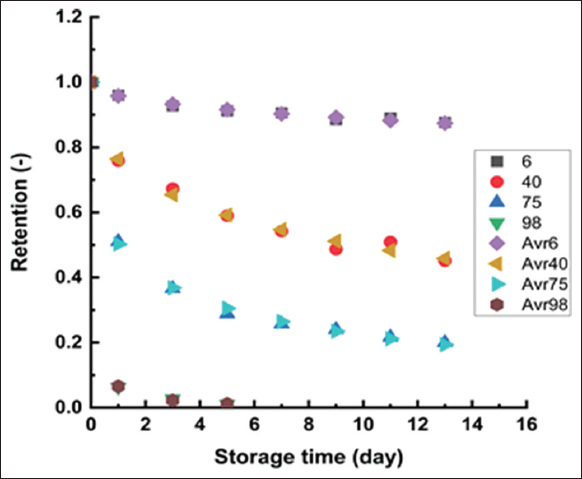 | Figure 2: Release behavior of garlic essential oil (GEO) from microencapsulated garlic essential oil (MGEO) powder in different relative humidity (RH). 6, 40, 75, 98: Retention of GEO at RH of 6%, 40%, 75% and 98%, respectively; Avr6, Avr40, Avr75, Avr98: Retention of GEO at RH of 6%, 40%, 75%, and 98% calculated using Avrami equation, respectively. [Click here to view] |
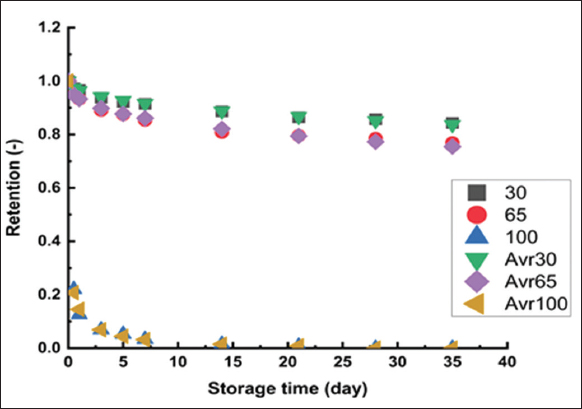 | Figure 3: Release behavior of garlic essential oil (GEO) from microencapsulated garlic essential oil (MGEO) powders in different temperatures. 30, 65, 100: Retention of GEO at temperatures of 30, 65, and 100°C, respectively; Avr30, Avr65, and Avr100: Retention of GEO at temperatures of 30, 65, and 100°C calculated by using Avrami equation, respectively. [Click here to view] |
The results of TGA revealed three stages of mass-loss: (I) 30–150°C (around 6.7%, evaporation of water and residual solvents); (II) 150–400°C (around 73%, decomposition of biopolymers and GEO); and (III) 400–600°C (around 16%, carbonaceous residue), as can be seen from Figure 1e. These results indicate that the MGEO powder remains thermally stable up to approximately 150°C, making them suitable for food and pharmaceutical applications.
XRD pattern exhibits broad and diffuse peaks, characteristic of an amorphous structure [Figure 1f]. This result indicated that the GEO is effectively encapsulated within the polymer matrix, inhibiting separate crystallization and thereby contributing to improved stability.
In summary, all FT-IR, TGA, XRD, and SEM data document the successful encapsulation of the GEO within the MD−γ-CD system. The MGEO powder exhibits thermal stability, an amorphous structure, and microsphere particles. These properties suggest effective oil retention and potential for controlled release. Compared with garlic oil encapsulated in β-CD reported by Piletti et al., the MGEO powder shows comparable thermal stability [22].
3.4. Release Behavior of GEO and Release Kinetics Modeling- Avrami Simulation
3.4.1. Effect of RH on Release Behavior of GEO from MGEO Powder
The effect of humidity on the release behavior was significant. At low humidity (6%), the release was very slow, reaching only 12.37% after 13 days, and the Avrami model yielding n ≈ 0.44 shows a Fickian diffusion-controlled mechanism. When RH increased to 40–75%, the release rate accelerated (k from 51% to 83%) while n slightly decreased (from 0.41 to 0.34), suggesting a transition toward anomalous diffusion. At 98% RH, complete release was reached within just 5 days, with a high-rate constant (k = 2.725), which means that the release mechanism changed to rapid erosion or degradation of the matrix.
3.4.2. Effect of Temperature
At 30°C, the release was very slow (15.73% after 35 days), a distinct characteristic of Fickian diffusion (n = 0.44). At 65°C, the release rate increased to 23.08%, with an anomalous diffusion mechanism (n = 0.39). At 100°C, complete release (100%) was achieved within 21 days, accompanied by a high-rate constant (k = 1.930), indicating that the release was ruled by an erosion-controlled mechanism.
3.4.3. Correlation of Parameters
The release kinetics of GEO from MGEO powders followed the Avrami model, with n values ranging from 0.30 to 0.44, and the rate constant k strongly depending on environmental conditions. At low RH (6%) and the temperature (30°C), k remained very small (0.001–0.037) and n ≈ 0.44, indicating that the release mechanism was mainly governed by Fickian diffusion through a stable CD–MD matrix. When the RH increased to 98%, or the temperature rose to 100°C, k exceeded 2.0 while n decreased to ~0.30, reflecting swelling and matrix erosion as the dominant release mechanism. The inclusion of γ-CD enhanced hydrogen bonding and strengthened the matrix, thereby slowing aroma loss and prolonging stability. These results are consistent with previous studies on spray-dried essential oil microcapsules [3].
3.5. Application in Nem chua Hue
To evaluate the potential application of MGEO in the preservation of fermented pork (Nem chua Hue), key quality parameters, including firmness, pH, and bacterial count, were monitored over a 7-day storage period.
The influence of MGEO on the firmness, pH, total aerobic bacteria, yeast and mold, and LAB count of Nem chua Hue during storage was revealed in Figures 4-6. It can be seen from Figure 4a that all displayed samples exhibited increased firmness over the storage period, reflecting the natural biochemical ripening of Nem chua Hue. Samples added with MGEO (0.01–0.02%) were generally firmer than the control (fresh garlic slice), particularly from days 5 to 7, indicating the impact of the MGEO on product structure. The pH gradually decreased from approximately 6.3–6.6 on day 1 to 4.2–4.7 on day 7, consistent with lactic acid fermentation, as can be seen from Figure 4b. MGEO-supplemented samples showed a slightly slower pH decrease compared to the control, suggesting a moderated inhibition of acid-producing microorganisms. Similar results were confirmed by Nguyen et al., when processing Nem chua by adding isolated LAB, with the pH reduced from 5.85 on day 0–4.14 on day 4 after fermentation [23].
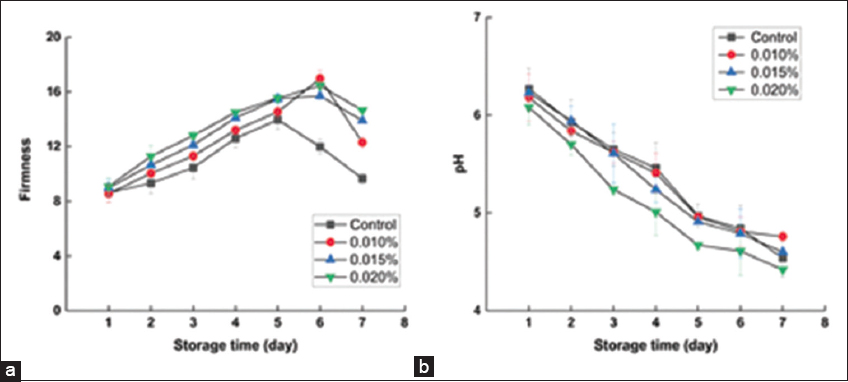 | Figure 4: Effect of added microencapsulated garlic essential oil powder on Nem chua Hue characteristics. (a) Firmness, (b) pH. [Click here to view] |
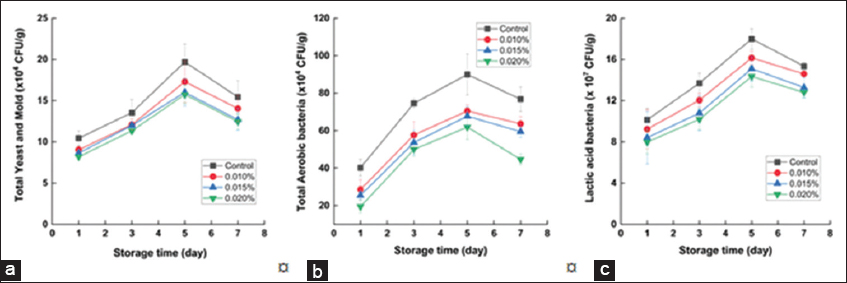 | Figure 5: Bacteria growth during storage time of Nem chua Hue. (a) Total yeast and molds, (b) Total aerobic bacteria, (c) Lactic acid bacteria. [Click here to view] |
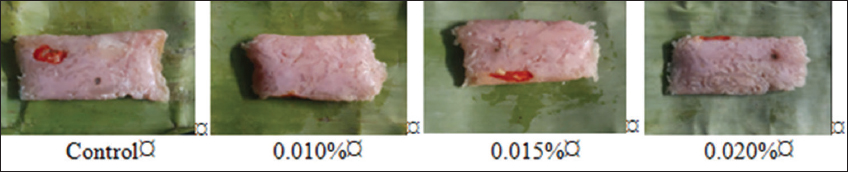 | Figure 6: Nem chua Hue after 5 days storage. [Click here to view] |
Figure 5a-c point out all the total yeast and mold, total aerobic bacteria, and LAB concentration increased dramatically from day 1 and reached the peak on day 5, and then slightly decreased to day 7 of storage time. MGEO-supplemented samples, especially at the concentration of 0.02%, had significantly lower microbial counts than that in the control sample, indicating sustained antibacterial activity during storage. Similar trends of pH, bacterial counts were observed in the study of Nguyen et al. [23]. However, the time to reach the peak of indicators in this study was slower than that reported by Nguyen et al., at 5 days rather than 2 days after processing [23].
The incorporation of MGEO in Nem chua Hue contributed to the product quality characteristics by maintaining firmness, adjusting pH reduction, and limiting aerobic bacterial growth. These findings highlight the potential application of MGEO as a natural preservative, contributing to extended shelf-life and improved microbiological safety.
Antibacterial efficacy increased with the increase of MGEO concentration (0.01% <0.015% <0.02%), confirming significant microbial inhibition during storage period. All MGEO-supplemented samples illustrated a slower pH reduction compared to the control sample, helping preserve product structure. The firmness of MGEO-supplemented samples in Figure 4a indicated effective maintenance of texture. Therefore, adding 0.015% MGEO balanced microbiological safety, sensory quality, and extended shelf-life.
The impact of MGEO on LAB count is a key factor because LAB are responsible for the acidification and flavor modification of Nem chua Hue. In the present study, MGEO caused only a moderate decrease in LAB counts. However, the fermentation process was not negatively affected, as the pH still decreased to the desired range of 4.5–5.0 within the fermentation time. This result agreed with previous studies showing that LAB are more tolerant to garlic-derived organosulfur compounds than spoilage or pathogenic microorganisms. Allicin in garlic mainly reacts with thiol (–SH) groups of microbial enzymes, which can inhibit cell metabolism [24]. At the applied concentration (0.015%), MGEO appeared to selectively suppress undesirable microorganisms, including aerobic bacteria, molds, and yeasts, while allowing LAB to remain active.
Table 3 presents the sensory scores of Nem chua Hue supplemented with MGEO at different concentrations. Color scores were not significantly different by the treatments, whereas odor, taste, and texture varied depending on the oil content. The sample containing 0.01% MGEO achieved the highest overall acceptability index (Overall acceptance index [OAI] = 6.80), reflecting positive perceptions of aroma and taste. At 0.02% MGEO, the OAI decreased to 5.98 due to the strong garlic odor, which limited consumer acceptance. The 0.015% MGEO treatment provided the most balanced outcome (OAI = 6.63), combining acceptable sensory quality with prolonged microbiological stability. Overall, 0.015% MGEO was identified as the optimal level, achieving a balance between sensory acceptability, microbial safety, and storage stability, whereas 0.01% was preferred when flavor was prioritized and 0.02% when maximum antibacterial protection was concerned. The sensory results revealed that the addition of MGEO did not significantly reduce overall acceptability. This confirms that microencapsulation effectively controlled the release of volatile compounds, preventing excessive aroma intensity while preserving the characteristic sensory profile of Nem chua Hue.
Table 3: Sensory attributes (day 7) and OAI
| Treatment | Color | Odor | Taste | Texture | OAI |
|---|---|---|---|---|---|
| Control | 5.9a±1.39 | 5.1b±1.25 | 5.1b±1.10 | 6.3b±0.70 | 5.60 |
| 0.010% GEO | 6.3a±1.28 | 7.1a±1.28 | 7.3a±1.10 | 6.5b±0.95 | 6.80 |
| 0.015% GEO | 6.3a±0.80 | 6.7a±0.92 | 6.4ab±1.06 | 7.1a±1.08 | 6.63 |
| 0.020% GEO | 6.2a±1.40 | 5.4b±1.35 | 4.9b±0.97 | 7.4a±1.20 | 5.98 |
OAI: (Colour+Aroma+Taste+Texture)/4. GEO: Garlic essential oil
From an application perspective, Nem chua Hue is commonly wrapped by banana leaves, fermented at room temperature over a few days, and stored under this condition where moisture availability is high. The Avrami results indicated that at high RH the GEO is completely released from MGEO within 5 days. Therefore, MGEO can provide a more sustained delivery of organosulfur compounds during fermentation and early storage, supporting inhibition of undesirable microorganisms, including aerobic bacteria, molds, and yeasts. This linkage helps explain the observed microbial reductions and the extension of Nem chua Hue’s shelf-life. Ultimately, MGEO offers a practical strategy to enhance microbial stability of Nem chua Hue without compromising sensory quality or traditional characteristics.
Although this study was mainly concerned with technological optimization and practical application rather than detailed antimicrobial mechanism elucidation, the sustained release of organosulfur compounds from MGEO can be responsible for the observed reduction in total aerobic bacteria and delayed acidification in Nem chua Hue. DATS and DADS, which are abundant in GEO, are widely reported to prevent microbial growth by disrupting cell membranes and interfering with enzymatic activity. In order to stabilize these volatile compounds and enable gradual release under fermentation and storage conditions, it is crucial to apply the MD–γ-CD encapsulation matrix. As a result, MGEO prevented excessive suppression of LAB necessary for fermentation while offering a more consistent antimicrobial action as compared to fresh garlic slices.
MGEO can be used as a natural preservative in fermented meat products since similar controlled-release benefits of encapsulated essential oils have been reported in food preservation systems.
4. CONCLUSION
With an encapsulation efficiency of around 92%, the MD–γ-CD combination produced stable microcapsules with effective regulated release of GEO.
With n ≈ 0.30–0.44, the release kinetics followed the Avrami model, indicating primarily Fickian diffusion under low RH conditions and a shift to erosion-controlled release at higher RH levels. This provided a logical basis for selecting storage and release conditions.
Supplementing Nem chua Hue with 0.01–0.02% MGEO considerably decreased total aerobics bacteria, yeasts, and molds, reduced acidification, and maintained LAB and product firmness. Among the tested levels, the highest microbiological safety was achieved at 0.02% MGEO, while the most balance between sensory acceptability and microbial control was at 0.015%.
In summary, this study presents an optimal set of encapsulating parameters (wall material MD–γ-CD, 5% GEO, inlet temperature 170°C) and recommended dosage of 0.015% MGEO for practical implementation to extend the shelf-life of Nem chua Hue without losing sensory acceptance.
5. ACKNOWLEDGMENTS
The authors gratefully acknowledge the facilities and support provided by the Faculty of Engineering and Food Technology (Hue University), the Faculty of Engineering (Vietnam National University of Agriculture), the Faculty of Chemical Engineering (Industrial University of Ho Chi Minh City), and the Institute of Advanced Technology (Vietnam Academy of Science and Technology).
6. AUTHORS’ CONTRIBUTIONS
All authors made substantial contributions to conception and design, acquisition of data, or analysis and interpretation of data; took part in drafting the article or revising it critically for important intellectual content; agreed to submit to the current journal; gave final approval of the version to be published; and agree to be accountable for all aspects of the work. All the authors are eligible to be author as per the International Committee of Medical Journal Editors (ICMJE) requirements/guidelines.
7. FUNDING
This research is funded by Ministry of Education and Training, Vietnam under grant number B2024-DHH-08.
8. CONFLICTS OF INTEREST
The authors declare that there are no conflicts of interest associated with this manuscript. Although one of the authors, Tran Viet Tai Duc, is affiliated with an industry organization (Unilever Vietnam International Company Limited, Cu Chi District, Ho Chi Minh City, Vietnam), this affiliation had no direct or indirect influence on the study design, experimental work, data interpretation, results, or manuscript preparation.
9. ETHICAL APPROVALS
This study involved only sensory evaluation of commonly consumed food products, with no medical intervention, invasive procedures, or biological sample collection. According to institutional guidelines of the University of Agriculture and Forestry, Hue University, such studies are exempt from formal ethical approval. The evaluation posed no foreseeable risk to participants. Participation was voluntary, with informed consent obtained from all individuals. No personal or sensitive data were collected, and an official institutional waiver statement is provided in the supplementary material.
10. DATA AVAILABILITY
All data from the current study are available from the corresponding author upon request.
11. PUBLISHER’S NOTE
All claims expressed in this article are solely those of the authors and do not necessarily represent those of the publisher, the editors and the reviewers. This journal remains neutral with regard to jurisdictional claims in published institutional affiliation.
12. USE OF ARTIFICIAL INTELLIGENCE (AI)-ASSISTED TECHNOLOGY
The authors declare that they have not used artificial intelligence (AI)-tools for writing and editing of the manuscript, and no images were manipulated using AI.
13. SUPPLEMENTARY MATERIAL
The supplementary material can be accessed at the journal’s website: https://jabonline.in/admin/php/uploadss/1473_pdf.pdf
REFERENCES
1. Moses RJ, Edo GI, Jikah AN, Agbo JJ. Bioactive compounds and biological activities of garlic. Curr Food Sci Technol Rep. 2024;2(2):111-20. [CrossRef]
2. Sousa VI, Parente JF, Marques JF, Forte MA, Tavares CJ. Microencapsulation of essential oils:A review. Polymers (Basel). 2022;14(9):1730. [CrossRef]
3. Shiga H, Yoshii H, Nishiyama T, Furuta T, Forssele P, Poutanen K, et al. Flavor encapsulation and release characteristics of spray-dried powder by the blended encapsulant of cyclodextrin and gum arabic. Dry Technol. 2001;19(7):1385-95. [CrossRef]
4. Yoshii H, Sakane A, Kawamura D, Neoh TL, Kajiwara H, Furuta T. Release kinetics of (−)-menthol from chewing gum. J Inclusion Phenom Macrocycl Chem. 2007;57(1):591-6. [CrossRef]
5. Yang S, Mao XY, Li FF, Zhang D, Leng XJ, Ren FZ, et al. The improving effect of spray-drying encapsulation process on the bitter taste and stability of whey protein hydrolysate. Eur Food Res Technol. 2012;235(1):91-7. [CrossRef]
6. Escobar-Avello D, Avendaño-Godoy J, Santos J, Lozano-Castellón J, Mardones C, von Baer D, et al. Encapsulation of phenolic compounds from a grape cane pilot-plant extract in hydroxypropyl beta-cyclodextrin and maltodextrin by spray drying. Antioxidants (Basel). 2021;10(7):1130. [CrossRef]
7. Watson MA, Lea JM, Bett-Garber KL. Spray drying of pomegranate juice using maltodextrin/cyclodextrin blends as the wall material. Food Sci Nutr. 2017;5(3):820-6. [CrossRef]
8. Eastman JE, Moore CO. Cold-water-soluble granular starch for gelled food compositions. US Patent US4465702A. 1984.
9. Altay Ö, Köprüalan Ö, ?lter I, KoçM, Ertekin FK, Jafari SM. Spray drying encapsulation of essential oils;process efficiency, formulation strategies, and applications. Crit Rev Food Sci Nutr. 2024;64(4):1139-57. [CrossRef]
10. Nguyen TVA, Yoshii H. Release behavior of allyl sulfide from cyclodextrin inclusion complex of allyl sulfide under different storage conditions. Biosci Biotechnol Biochem. 2018;82(5):848-55. [CrossRef]
11. Greenspan L. Humidity fixed points of binary saturated aqueous solutions. J Res Natl Bur Stand A Phys Chem. 1977;81(1):89-96. [CrossRef]
12. Soottitantawat A, Yoshii H, Furuta T, Ohgawara M, Forssell P, Partanen R, et al. Effect of water activity on the release characteristics and oxidative stability of D-limonene encapsulated by spray drying. J Agric Food Chem. 2004;52(5):1269-76. [CrossRef]
13. Lim J. Hedonic scaling:A review of methods and theory. Food Qual Prefer. 2011;22(8):733-47. [CrossRef]
14. Dehariya N, Guha P, Gupta RK. Extraction and characterization of essential oil of garlic (Allium sativa L.). Int J Chem Stud. 2021;9(1):1455-9. [CrossRef]
15. Satyal P, Craft JD, Dosoky NS, Setzer WN. The chemical compositions of the volatile oils of garlic (Allium sativum) and wild garlic (Allium vineale). Foods. 2017;6(8):63. [CrossRef]
16. Astray G, Gonzalez-Barreiro C, Mejuto JC, Rial-Otero R, Simal-Gandara J. A review on the use of cyclodextrins in foods. Food Hydrocoll. 2009;23(7):1631-40. [CrossRef]
17. Reineccius GA. The spray drying of food flavors. Dry Technol. 2004;22(6):1289-324. [CrossRef]
18. Gharsallaoui A, Roudaut G, Chambin O, Voilley A, Saurel R. Applications of spray-drying in microencapsulation of food ingredients:An overview. Food Res Int. 2007;40(9):1107-21. [CrossRef]
19. Mohammed NK, Tan CP, Manap YA, Muhialdin BJ, Hussin ASM. Spray drying for the encapsulation of oils—A review. Molecules. 2020;25(17):3873. [CrossRef]
20. De Barros Fernandes RV, Marques GR, Borges SV, Botrel DA. Effect of solids content and oil load on the microencapsulation process of rosemary essential oil. Ind Crops Prod. 2014;58:173-81. [CrossRef]
21. Ren W, Tian G, Zhao S, Yang Y, Gao W, Zhao C, et al. Effects of spray-drying temperature on the physicochemical properties and polymethoxyflavone loading efficiency of citrus oil microcapsules. LWT. 2020;133:109954. [CrossRef]
22. Piletti R, Zanetti M, Jung G, De Mello JMM, Dalcanton F, Soares C, et al. Microencapsulation of garlic oil by b cyclodextrin as a thermal protection method for antibacterial action. Mater Sci Eng C Mater Biol Appl. 2019;94:139-49. [CrossRef]
23. Nguyen H, Elegado F, Librojo-Basilio N, Mabesa R, Dizon E. Isolation and characterisation of selected lactic acid bacteria for improved processing of Nem chua, a traditional fermented meat from Vietnam. Benef Microbes. 2009;1(1):67-74. [CrossRef]
24. Sarfraz M, Nasim MJ, Jacob C, Gruhlke MC. Efficacy of allicin against plant pathogenic fungi and unveiling the underlying mode of action employing yeast based chemogenetic profiling approach. Appl Sci. 2020;10(7):2563. [CrossRef]